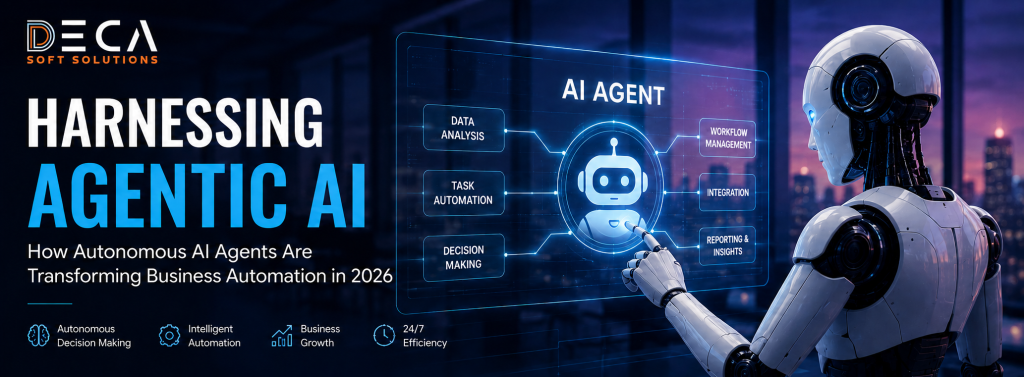
Harnessing Agentic AI: How Autonomous AI Agents Are Transforming Business Automation in 2026
Autonomous AI agents—also known as agentic AI—are rapidly moving from proof‑of‑concept to mainstream adoption. Unlike traditional automation, which executes predefined tasks, agentic systems can plan, act and adapt in pursuit of a goal. A recent agentic AI market analysis reports that 79 percent of companies already use AI agents and that almost 40 percent of enterprise applications will embed AI agents by 2026. As adoption climbs, organizations need to understand what agentic AI is, how it differs from robotic process automation (RPA) and hyperautomation, and how to implement it responsibly. This article explains the technology, benefits and risks, provides a step‑by‑step adoption roadmap, and positions Deca Soft Solutions as your expert partner.
What Is Agentic AI?
Agentic AI refers to intelligent systems capable of autonomously planning and executing tasks to achieve specific business goals. Unlike conventional RPA bots, which follow scripted steps, agentic agents perceive their environment, decide on actions, and collaborate with other agents and humans. They draw on large language models (LLMs), machine learning, knowledge graphs and reinforcement learning to make context‑aware decisions.
A key distinction is multi‑agent orchestration. Instead of a single monolithic model, organizations deploy a network of specialized agents—sometimes called a “swarm.” Each agent focuses on a specific task (e.g., document gathering, compliance checking or recommendation) and collaborates with others to complete complex workflows. Research shows that federated multi‑agent systems can complete processes more efficiently with up to 60 percent fewer errors, optimize costs by using smaller specialized models, and improve resilience by avoiding vendor lock‑in.
An agentic operating system underpins these capabilities. It includes:
- Orchestration – Coordinating handoffs between humans, RPA bots and AI agents across complex workflows.
- Governance – Built‑in guardrails that enforce policies and ensure transparent, compliant decisions.
- Adaptability – A modular, composable architecture that allows teams to plug in new models or data sources without disrupting existing systems.
When combined with reliable data pipelines and robust security, this architecture enables autonomous agents to handle end‑to‑end processes that previously required human judgment.
Agentic AI vs. RPA vs. Hyperautomation
Understanding how agentic AI fits into the automation landscape is critical for selecting the right strategy.
| Capability | RPA | Hyperautomation | Agentic AI |
|---|---|---|---|
| Automation scope | Repetitive, rule‑based tasks | End‑to‑end processes using RPA + AI + process mining | Goal‑driven tasks with planning and autonomous decision‑making |
| Intelligence level | Scripted workflows | Uses AI for document understanding & analytics | Agents learn and adapt using LLMs, reinforcement learning and multi‑agent collaboration |
| Orchestration | Sequential bot execution | Central orchestration across multiple tools | Swarm of agents orchestrated via an agentic command center |
| Governance | Manual exception handling | Governance frameworks but often bolt‑on | Governance‑as‑code embedded into each agent |
| Typical use case | Invoice processing, data entry | Order‑to‑cash, onboarding, finance workflows | Dynamic decision‑making, personalized customer journeys, autonomous software testing |
Hyperautomation remains an important stepping stone; it integrates RPA, AI, machine learning and process mining to automate complex processes. However, agentic AI extends beyond automation by giving systems the autonomy to take initiative, learn from feedback and collaborate with other agents. Enterprises should view agentic AI as the next evolutionary stage rather than a replacement—hybrid deployments that combine RPA bots, hyperautomation and agents will remain common.
Why Agentic AI Matters in 2026
Several market trends underscore why agentic AI is poised to reshape business automation:
- Exploding adoption – A 2026 market report notes that 79 percent of companies already use AI agents and that 40 percent of enterprise applications will embed AI agents by 2026. This shift from experimentation to scale means agents are becoming a standard feature across CRMs, ERPs and other core systems.
- Productivity and cost gains – Roughly 66 percent of organizations using AI agents report productivity improvements and 57 percent achieve cost savings. By automating decision‑making, agents free employees to focus on creative and strategic work.
- Budget expansion – Nearly 88 percent of executives plan to increase AI budgets because of agentic AI initiatives, reflecting strong commercial intent.
- Autonomous decisions – Around 15 percent of day‑to‑day business decisions could soon be made autonomously by AI agents, shifting the operating model from human‑driven to AI‑driven.
- Industry momentum – Healthcare, financial services and retail are leading adopters; healthcare institutions use agents for clinical documentation, diagnostics and patient monitoring, while banks use them for fraud detection and risk analysis.
These statistics signal that agentic AI is no longer speculative. Businesses that embrace agents early can gain a competitive advantage through faster decision‑making, improved customer experiences and reduced operating costs.
Use Cases and Real‑World Examples
Agentic AI’s versatility spans numerous functions. Below are examples of how autonomous agents are being applied across industries:
Loan Processing in Financial Services
A consumer bank might deploy a network of AI agents to handle end‑to‑end loan processing. One agent gathers required documents from applicants, a second validates data against credit bureaus, a third runs risk and compliance checks, and a fourth prepares personalized offers. This “swarm” approach reduces errors, optimizes costs and enhances resilience because specialized agents can be swapped without vendor lock‑in.
Healthcare and Life Sciences
Hospitals use agentic AI to automate clinical documentation, patient intake and diagnostics. Agents read medical imaging, extract relevant information from unstructured notes and update electronic health records. A reported 71 percent of non‑federal acute care hospitals already use predictive AI, and many are now layering agentic capability on top of these models to automate treatments and schedule follow‑ups.
Retail and E‑Commerce
Retailers employ agents to manage inventory, personalize product recommendations and answer customer queries. Some implementations have produced a 9.7 percent increase in sales due to proactive engagement. Agents can monitor customer behavior across channels, predict demand and trigger supply‑chain actions without human intervention.
Insurance Claims and Underwriting
Insurance providers deploy agents to triage claims, verify policy details, detect fraud and recommend settlement amounts. AI agents that accelerate prior authorization for insurers can reduce claim turnaround by over 70 percent and dramatically improve customer satisfaction.
Software Testing and DevOps
Agentic AI also transforms IT operations. Autonomous test agents generate test cases, execute them, detect anomalies and update pipelines. This approach accelerates releases and improves software quality while allowing human engineers to focus on new features.
Building the Foundations: Data, Governance and Architecture
Agentic AI success depends on robust foundations. Three critical pillars are:
- Centralized orchestration – An agentic command center coordinates the work of multiple agents, RPA bots and human users, ensuring workflows remain synchronized and auditable.
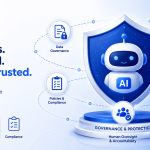
- Governance‑as‑code – Rather than applying policies manually, organizations embed rules, permissions and approval logic directly into agents. This approach enforces least‑privilege access, real‑time policy checks and human‑in‑the‑loop approvals for sensitive actions.
- Data strategy – Agents need enriched metadata and ontologies to understand relationships and context, zero‑copy architectures that let them query data in place without moving it, and proprietary data moats (e.g., telemetry, service logs, customer history) to differentiate capabilities.
Without these foundations, agents may behave unpredictably or compromise security. Organizations should invest early in data cataloging, identity and access management (IAM), and observability tools before deploying large fleets of agents.
Step‑by‑Step Roadmap for Agentic AI Adoption
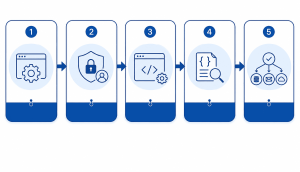
- Assess readiness – Evaluate which business processes could benefit from agentic capabilities. Look for workflows that involve dynamic decision‑making, unstructured data and frequent human handoffs. Conduct a risk assessment to identify compliance concerns.
- Define clear objectives – Set measurable goals (e.g., reduce loan processing time by 50 percent, improve first‑contact resolution in customer support, or decrease compliance violations).
- Build a pilot – Start with a single high‑value use case. Assemble a cross‑functional team of process owners, data engineers, AI specialists and risk managers. Design the agent workflow, select appropriate models (LLMs, reinforcement learning, domain‑specific models) and integrate data sources.
- Establish an agentic command center – Implement orchestration tools (e.g., n8n, Workato or UiPath Orchestrator) to coordinate agents, RPA bots and human actions. Build observability dashboards to trace agent decisions, outcomes and errors.
- Embed governance‑as‑code – Define policies, data access rules, and human‑approval thresholds. Use policy engines so that agents check permissions before acting. Maintain detailed logs for auditability.
- Scale iteratively – Once the pilot demonstrates ROI, expand to adjacent processes. Use modular agent architectures so that new agents can be added without disrupting existing workflows.
- Upskill teams – Train employees on AI ethics, prompt engineering, agent orchestration and model monitoring. Prepare for new roles such as AI security engineer and interaction designer.
- Continuously monitor and optimize – Track KPIs (cycle time, accuracy, cost savings, customer satisfaction). Retrain models with fresh data, update policies and refine prompts to improve agent performance.
Pros and Cons of Agentic AI
| Pros | Cons |
|---|---|
|
|
Decision Framework: When to Use Agentic AI
Organizations should evaluate whether a process is suitable for agentic AI by considering the following factors:
- Task complexity – If the task involves dynamic decision‑making, reasoning over unstructured data or coordinating multiple systems, agentic AI is a strong fit. For simple, repetitive tasks, RPA or hyperautomation may suffice.
- Volume and variability – High‑volume processes with unpredictable inputs (e.g., unstructured customer requests) benefit from autonomous agents that can adapt on the fly.
- Risk tolerance and compliance – Processes subject to strict regulations require robust governance‑as‑code and human approval. If the risk is low, agents may operate autonomously; if the risk is high, human‑in‑the‑loop is essential.
- Data maturity – Agentic AI needs reliable, well‑tagged data. Organizations with mature data cataloging, metadata and ontologies are better positioned to deploy agents successfully.
- Organizational readiness – Consider whether teams are prepared to adopt new roles and whether leadership is committed to AI transformation.
Best Practices for Successful Adoption
- Start small, scale fast – Launch a pilot with clear KPIs; demonstrate value before expanding.
- Leverage modular, open platforms – Tools like n8n, Workato and Zapier enable integration with existing systems and can orchestrate both RPA bots and AI agents. Choose platforms that support API integration, event‑driven workflows and easy plug‑ins for new models.
- Prioritize data security – Implement least‑privilege access and sandbox environments. Monitor data usage and enforce real‑time policy checks.
- Focus on ethical AI – Define fairness, accountability and transparency guidelines. Build human‑approval checkpoints for sensitive decisions.
- Invest in people – Train staff in AI literacy, prompt engineering and agent orchestration. Encourage collaboration between domain experts, data engineers and automation specialists.
- Measure continuously – Track metrics such as cycle time reduction, accuracy improvement, cost savings, customer satisfaction and employee engagement. Use these metrics to iteratively improve your agents.
Future Outlook: What’s Next for Agentic AI?
The pace of innovation suggests that agentic AI will soon become a core operating model. The shift from single monolithic models to federated multi‑agent systems will enable organizations to tailor agents to specific tasks and swap them out as needed. The emergence of agentic command centers will bring greater orchestration and observability to digital workforces. Governance‑as‑code will mature, embedding policies and human‑approval logic into every agent. Data foundations will evolve through enriched metadata, zero‑copy architectures and proprietary data moats.
New roles such as AI security engineers and interaction designers will be essential to ensure safe, intuitive collaboration between humans and agents. As AI becomes more agentic, organizations must embed ethics, security and human oversight into design. Those that do will unlock faster innovation, superior customer experiences and sustainable competitive advantage.
Related Articles from Deca Soft Solutions
- Hyperautomation Explained: How Businesses Can Go Beyond RPA in 2025
- How AI and RPA Are Shaping the Future of Hyper‑Intelligent Workflows
- End‑to‑End Workflow Automation for SaaS Businesses
- Automation in Finance: How RPA Is Transforming Accounting and Reporting
- RPA in Customer Experience: How Automation Is Redefining CX in 2025
Frequently Asked Questions
What is agentic AI?
Agentic AI refers to autonomous AI systems that can plan, decide and act toward a goal. These systems use large language models, machine learning and multi‑agent architectures to carry out tasks without constant human scripting.
How are AI agents different from chatbots?
Chatbots primarily handle conversations and respond to predefined queries. AI agents go beyond chat; they can interact with multiple systems, trigger actions, orchestrate workflows and make decisions based on context and policies.
Is agentic AI replacing RPA?
No. RPA remains valuable for simple, repetitive tasks. Agentic AI complements RPA by handling complex, dynamic workflows that require reasoning and adaptation. Most organizations will use both.
What industries benefit most from agentic AI?
Financial services, healthcare, retail, insurance and technology sectors are early adopters. However, any industry with complex workflows, large volumes of unstructured data and high compliance requirements can benefit.
Are AI agents secure?
Security depends on implementation. Best practices include governance‑as‑code, least‑privilege access, human‑approval checkpoints and continuous monitoring. When implemented properly, agentic systems can be as secure as or more secure than human‑driven processes.
How can I get started with agentic AI?
Begin with a readiness assessment, choose a high‑impact pilot process, build a cross‑functional team and implement a modular architecture. Engage an experienced partner like Deca Soft Solutions to guide design, governance and integration.
Ready to Transform Your Business with Agentic AI?
Agentic AI is reshaping the future of automation. By adopting autonomous agents now, you can unlock faster innovation, elevate customer experiences and maintain a competitive edge. Deca Soft Solutions has deep expertise across AI automation, RPA, agentic AI design, n8n and custom integrations. We help companies assess readiness, design modular agent architectures, embed governance‑as‑code and integrate agents with existing systems. Contact us today to explore how agentic AI can transform your business.