Vertical AI Agents: Domain-Specific Intelligence for Industry Automation
Key Takeaways
- Vertical AI agents are purpose-built for a single industry or function — trained on domain-specific data and workflows rather than broad general knowledge.
- They consistently outperform general-purpose AI on precision tasks, with industry research from EY and Aisera pointing to efficiency improvements exceeding 40% in sectors like healthcare, manufacturing, finance, and FMCG.
- The core architecture combines a domain-tuned language model, a reasoning engine, a cognitive skills module, tool connectors, memory storage, and a governance layer — each component adding a specific capability the general AI stack lacks.
- Horizontal and vertical agents are not mutually exclusive: many enterprises deploy horizontal agents for cross-team workflows and vertical agents for high-stakes, domain-specific tasks.
- Governance-first design — embedding permission boundaries, decision logs, and human approval checkpoints from the start — is essential for regulated deployments.
Introduction
General-purpose AI has proven its value across a wide range of business tasks. But ask a horizontal AI model to correctly interpret a clinical lab value, flag a suspicious derivatives trade under MiFID II, or evaluate a contract clause against your specific industry’s standard terms — and the limits of breadth over depth become apparent. The model may produce a plausible-sounding answer that is subtly wrong in ways only a domain expert would catch.
Vertical AI agents are built to solve exactly that problem. Instead of trying to be useful across every industry, they are designed to be authoritative within one. They are trained on the terminology, workflows, regulations, and edge cases that define a specific domain — and that specialisation is what makes them genuinely useful for the decisions that matter most.
In 2026, vertical agents are moving from pilot projects into production deployments across healthcare, manufacturing, financial services, and consumer goods. This guide explains what they are, how they are built, where they add the most value, and how to implement them in a way that meets the governance standards that regulated industries require.
If you are new to agentic AI in general, our guide on how autonomous AI agents are transforming business automation provides the broader context before you focus on domain-specific deployments.
What Are Vertical AI Agents?
A vertical AI agent is an autonomous AI system designed to operate within a specific industry, function, or use case. Where a horizontal agent is built for breadth — capable of drafting emails, summarising reports, and answering general questions across any department — a vertical agent is built for depth. It understands the regulatory language of its domain, recognises the edge cases that domain experts deal with daily, and is calibrated to produce outputs that meet the accuracy standards the industry requires.
The distinction matters because precision requirements vary dramatically between domains. A customer service chatbot that gives a slightly vague answer is mildly unhelpful. A clinical decision support agent that misinterprets a drug interaction, or a credit risk agent that fails to apply the correct regulatory threshold, causes real harm. Vertical agents are trained and governed to meet the higher bar that high-stakes domains demand.
In practice, vertical agents are built on domain-specific large language models (LLMs) that have been fine-tuned on specialised corpora — clinical notes, financial filings, supply chain records, legal contracts — combined with reasoning engines and compliance modules that embed regulatory logic directly into the decision-making layer.
Horizontal vs. Vertical AI Agents: A Side-by-Side Comparison
Understanding how the two approaches differ helps you make the right deployment decision for each use case in your organisation. The two are not in competition — most enterprises will find a place for both.
| Dimension | Horizontal AI Agents | Vertical AI Agents |
|---|---|---|
| Scope | Broad — designed to support many departments and use cases simultaneously | Narrow — purpose-built for one industry, function, or problem space |
| Training data | Diverse, generalised datasets; good coverage, limited domain nuance | Specialised corpora tuned to industry terminology, workflows, and regulations |
| Accuracy on domain tasks | Adequate for general tasks; may require significant prompt engineering for specialist work | High precision within the target domain; fewer misinterpretations on domain-specific inputs |
| Implementation effort | Lower upfront — faster to deploy across multiple teams | Higher upfront — data preparation and model tuning take longer, but the integration is tighter |
| Regulatory fit | General compliance posture; risk of missing sector-specific requirements | Regulatory logic embedded in the model and workflow; better suited for highly regulated industries |
| Best suited for | Cross-departmental analytics, general process automation, prototyping | Precision-critical tasks: fraud detection, clinical decision support, demand forecasting, supply-chain optimisation |
The practical recommendation is not to choose one over the other — it is to deploy each where it is strongest. Horizontal agents handle the broad workflow layer; vertical agents handle the specialist tasks where accuracy and compliance are non-negotiable.
Benefits of Domain-Specific AI Agents
The case for vertical agents rests on several concrete advantages that become particularly visible in complex, regulated, or high-volume environments.
- Deep domain expertise from day one. Because the model is fine-tuned on domain-specific data, it understands the terminology, regulatory requirements, and decision frameworks of the field without extensive prompt engineering. Your team is not teaching the AI what an EBITDA covenant or a contraindication means — it already knows.
- Real-time adaptability within the domain. Vertical agents can monitor incoming data streams and respond to changes automatically — flagging a production anomaly on the factory floor, adjusting an investment portfolio in response to a market movement, or escalating a patient’s vitals to a clinician — all within the parameters their governance layer permits.
- End-to-end workflow automation. A well-built vertical agent does not just answer questions — it executes processes. A healthcare agent can move from initial symptom triage through to appointment scheduling, insurance pre-authorisation, and follow-up reminders without a human touching each step. A financial agent can move from fraud signal detection through to payment suspension and compliance logging within seconds.
- Higher accuracy and measurable efficiency gains. Industry research from EY and Aisera indicates that vertical agents can deliver efficiency improvements exceeding 40% compared to general AI in domains like healthcare, manufacturing, finance, and FMCG — primarily because the reduction in misinterpretation and the elimination of manual correction cycles compounds quickly at scale.
- Embedded compliance. Rather than checking outputs against regulatory rules after the fact, vertical agents embed those rules into the decision logic. A credit agent that is built to comply with fair-lending regulations does not need a separate compliance review step on every decision — the boundary is part of the agent’s operating parameters.
- Modular scalability. You can deploy a vertical agent in one department — finance, HR, clinical operations — validate its performance, and expand it to adjacent functions without re-architecting the underlying system. The modular design of vertical agent architectures makes this kind of phased rollout significantly easier than it would be with a monolithic AI deployment.
Industry Use Cases
Vertical agents are gaining the most traction in industries where regulatory complexity, specialised terminology, and the cost of error are all high. Here is how they are being applied across four major sectors.
1. Healthcare
Healthcare AI is moving beyond predictive analytics into active clinical assistance. Vertical agents in this space monitor patient vitals in real time, flag deteriorating conditions, suggest evidence-based interventions, assist with referral routing, and help manage the administrative burden of insurance claims and scheduling — all within the governance boundaries that clinical governance requires.
Trigger → Action: Remote patient monitoring device records a drop in oxygen saturation below a defined threshold → Vertical agent cross-references the reading against the patient’s clinical history and current medications → Agent flags the case as high-priority → Sends an alert to the on-call clinician with a structured summary → Logs the event and the recommended intervention to the patient’s electronic health record.
Example: A private hospital network deploys a vertical agent to assist its oncology team with clinical trial matching. The agent ingests patient records, cross-references them against active trial eligibility criteria, and produces a ranked list of suitable trials for each patient — a process that previously required a senior research nurse to spend several hours per patient. Matching time drops from three hours to under 20 minutes per case.
2. Manufacturing
In manufacturing, vertical agents are evolving the concept of predictive maintenance into something closer to autonomous factory management. They monitor equipment sensor data in real time, detect fault signatures before failure occurs, initiate work orders, adjust production schedules to accommodate unplanned maintenance, and manage supplier reordering when inventory drops below threshold — all without waiting for a human to notice and respond.
Trigger → Action: Vibration sensor on a CNC machine registers an anomalous pattern → Vertical agent classifies the signature as a bearing-wear precursor based on domain-trained fault models → Agent schedules a maintenance window during the next planned downtime slot → Logs a work order in the CMMS → Adjusts the production schedule to re-sequence affected jobs → Notifies the shift supervisor with a plain-language summary.
Example: An automotive components manufacturer deploys a vertical agent across its pressing line. Within three months, unplanned downtime events fall by 34% as the agent begins catching fault signatures 48–72 hours before a failure would have occurred — shifting the maintenance team from reactive repair to scheduled replacement.
3. Financial Services
Financial vertical agents handle a range of real-time tasks that require both speed and regulatory precision: fraud signal detection, credit risk scoring, transaction anomaly classification, and portfolio rebalancing. The key differentiator from general AI is the embedded regulatory logic — the agent is not just pattern-matching, it is applying sector-specific rules about what actions it can take autonomously and which ones require human sign-off.
Trigger → Action: Payment instruction arrives that deviates from a customer’s established behaviour profile → Vertical agent scores the transaction against a domain-trained fraud model → Confidence score exceeds the suspension threshold → Agent places a temporary hold on the payment → Sends a verification request to the customer via secure channel → Logs the intervention with full audit trail for compliance reporting → If the customer confirms the transaction, the hold is released automatically.
Example: A retail bank integrates a vertical fraud detection agent into its real-time payment processing pipeline. The agent reviews every outbound transfer against a behavioural model built on two years of transaction history. False positive rates drop by 28% compared to the previous rule-based system — reducing customer friction — while the detection rate for genuine fraud improves by 19%.
4. Fast-Moving Consumer Goods (FMCG)
FMCG companies operate at the intersection of volatile demand, complex supply chains, and strict product safety regulations. Vertical agents in this sector manage demand forecasting, stock replenishment, promotional compliance checks, and safety incident detection — often working as a coordinated multi-agent system where each sub-agent owns a specific function and the orchestration layer manages the handoffs.
Trigger → Action: Demand forecasting agent detects a projected stockout for a key SKU in a specific region 12 days out → Alert is passed to the replenishment agent → Replenishment agent checks available inventory across distribution centres and calculates the optimal transfer order → Order is raised automatically if within approved parameters → If the order value exceeds the autonomous approval threshold, it is routed to the procurement manager for sign-off.
Example: A personal care products company deploys a multi-agent system across its European supply chain. The demand forecasting and replenishment agents reduce out-of-stock events by 31% over the first quarter of deployment, while the promotional compliance agent catches three label-claim violations before they reach retail shelves — avoiding a potential product recall.
5. Other Domains
Vertical agents are also gaining traction in legal services (contract clause analysis and risk flagging), logistics (dynamic route optimisation in response to real-time traffic and weather data), energy (grid load balancing and renewable output forecasting), and HR (compliance-aware employee onboarding and policy Q&A). The common thread is regulatory complexity combined with high decision volume — exactly the conditions where domain-specific intelligence compounds its advantage over general AI.
Architecture and Building Blocks
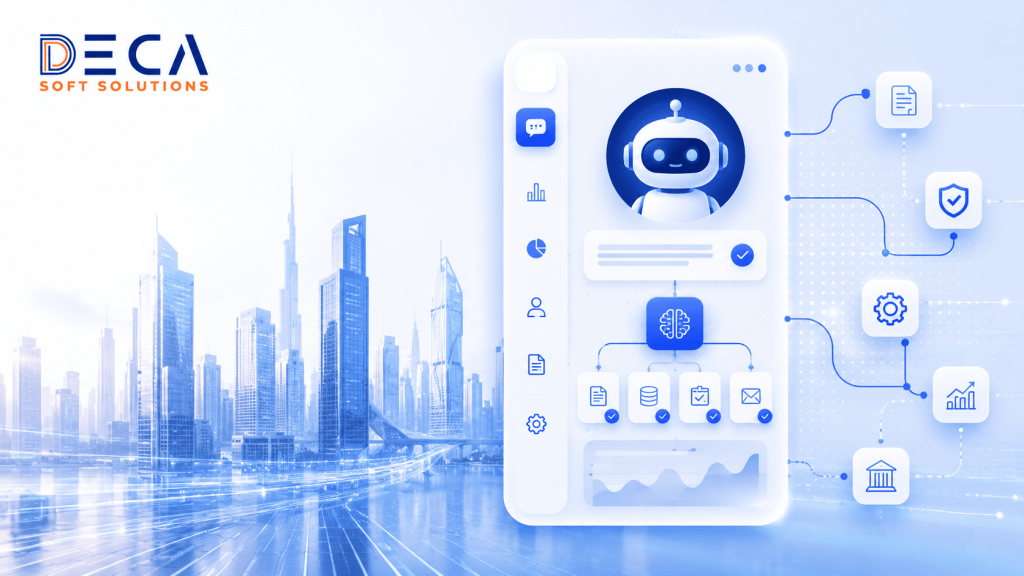
A vertical AI agent is not a single model — it is a system of components, each handling a specific layer of the agent’s capability. Understanding the architecture helps you make informed decisions about where to invest in custom development versus where to use existing platforms.
Domain-Specific Language Model
The foundation of any vertical agent is a language model fine-tuned on domain-specific corpora. This might be clinical notes and medical literature for a healthcare agent, regulatory filings and analyst reports for a financial agent, or maintenance records and engineering manuals for a manufacturing agent. The fine-tuning process calibrates the model’s vocabulary, reasoning patterns, and output style to match the domain — reducing the misinterpretations that occur when a general model encounters specialist terminology.
Reasoning Engine
The reasoning engine is the orchestration layer that sits above the language model. It interprets the intent behind incoming requests, decomposes complex tasks into sub-tasks, routes each sub-task to the appropriate module or sub-agent, and reassembles the results into a coherent output. For multi-step processes — a full contract review, a clinical care pathway, a fraud investigation — the reasoning engine is what keeps the agent on track across multiple turns and data sources.
Cognitive Skills Module
The cognitive skills module provides purpose-built inference capabilities that the base language model alone cannot deliver. These might include a domain-specific classifier trained to identify regulatory risk in contract text, a fault-classification model trained on sensor data from a specific machine type, or a compliance monitor that checks outputs against a rule set before they are delivered to the user. This layer is where the domain expertise becomes operationally actionable.
Tools and Connectors
Vertical agents need to interact with the systems your organisation already runs. Tools and connectors provide the integration layer: APIs to CRM, ERP, and clinical systems; database connections for real-time data retrieval; IoT device interfaces for sensor data; and workflow automation connectors to platforms like n8n, Make, or Workato for downstream action execution. Retrieval-Augmented Generation (RAG) modules also belong here — allowing the agent to query a domain knowledge base at inference time rather than relying solely on what is baked into the model weights.
Memory and Context Store
For tasks that unfold over multiple steps or across multiple interactions — a multi-day clinical case, a complex fraud investigation, an ongoing contract negotiation — the agent needs persistent memory. The context store maintains conversation history, intermediate reasoning outputs, and relevant domain facts across the lifecycle of a task, allowing the agent to pick up where it left off without requiring the user to repeat context.
Governance and Safety Layer
For regulated industries, this layer is not optional. The governance layer implements the permission boundaries, decision logging, approval checkpoints, and privacy filters that allow the agent to operate autonomously without exposing the organisation to regulatory or reputational risk. We cover governance design in detail in our post on AI agent governance and security for compliant autonomous systems.
Implementation Framework: Eight Steps to Production
Deploying a vertical AI agent is a more deliberate process than deploying a general-purpose tool. The upfront investment in data quality, model selection, and governance design pays back through significantly higher accuracy and lower remediation costs in production.
Step 1 — Identify Your High-Impact Use Case
Start with a single, clearly scoped problem where precision matters and the current manual process is measurably costly. Fraud detection, demand forecasting, clinical decision support, and compliance document review are all strong candidates. Avoid starting with a use case so broad that success is impossible to define — narrow scope, clear baseline metrics, measurable outcome.
Step 2 — Assess Data Readiness
A vertical agent is only as good as the domain data it is trained and grounded on. Before selecting a model, audit your data: Is it labelled? Is it structured? Does it cover the edge cases the agent will encounter in production? Are there privacy or regulatory constraints on using it for training? Answering these questions before you start model selection saves significant time and avoids surprises during fine-tuning.
Step 3 — Select or Fine-Tune a Domain Model
Evaluate whether an existing domain-specific model is available for your industry — medical LLMs, financial LLMs, and legal LLMs are all commercially available and increasingly performant. If no suitable model exists, fine-tune a capable base model on your proprietary dataset. Assess open-source and commercial options against your performance requirements, data licensing constraints, and operational cost profile.
Step 4 — Build the Reasoning Engine and Cognitive Skills
Implement a modular orchestration layer that routes tasks to the right sub-agents or modules, integrates your compliance logic, and manages the sequencing of multi-step processes. Frameworks like n8n and LangChain provide building blocks; custom orchestration may be necessary for complex, high-throughput use cases with tight latency requirements.
Step 5 — Integrate with Your Existing Systems
Connect the agent to the data sources and action targets it needs: your CRM, ERP, clinical record system, IoT platform, or data warehouse. Define the data schema the agent will consume and the output format your downstream systems expect. Treat every integration point as a potential failure mode and build error handling into the workflow from the start.
Step 6 — Run a Controlled Pilot
Deploy in a limited production environment with explicit human oversight. Define your success criteria before the pilot starts — accuracy thresholds, escalation rates, processing time targets — and instrument the agent to capture the data you need to evaluate against them. Gather feedback from the domain experts who will be working alongside the agent and incorporate it before scaling.
Step 7 — Scale Gradually by Department
Once the pilot validates performance against your criteria, expand to adjacent use cases or departments rather than attempting an organisation-wide rollout. Each expansion is an opportunity to validate that the governance controls hold and that the model’s performance generalises beyond the pilot scope.
Step 8 — Monitor and Govern Continuously
Instrument your production deployment with performance dashboards and automated alerting. Track domain-specific metrics alongside standard AI performance metrics — a financial fraud agent should be tracked on false positive rate and investigation accuracy, not just latency. Schedule regular governance reviews and document all model updates and policy changes as part of your audit trail.
Governance and Compliance for Vertical AI Agents
The industries where vertical agents add the most value — healthcare, finance, manufacturing, legal — are precisely the industries with the strictest governance requirements. Governance is not an add-on; it is a structural requirement for any regulated deployment.
- Permission boundaries: Define at the system level what the agent may do autonomously and what requires human approval. A fraud detection agent may suspend a payment autonomously but must escalate a fund transfer above a defined threshold to a human reviewer. These boundaries are implemented in the governance layer and enforced programmatically — they cannot be overridden by the model’s own reasoning.
- Decision logging: Every action the agent takes — every input it received, every output it produced, every system it updated — is recorded in a tamper-evident audit log. This log is your primary evidence in a regulatory inquiry and your primary tool for diagnosing unexpected behaviour in production.
- Human-in-the-loop checkpoints: For high-impact decisions, the workflow pauses and routes to a named human reviewer before proceeding. The reviewer’s decision — approve, modify, or reject — is itself logged and becomes part of the audit trail.
- Bias and fairness monitoring: Domain-specific fairness metrics should be tracked alongside standard performance metrics. A credit risk agent should be monitored for differential approval rates across demographic groups; a clinical agent should be monitored for performance variation across patient subpopulations.
- Model versioning and change management: Every update to the domain model, the cognitive skills module, or the governance rules is tracked as a versioned change. This ensures reproducibility — if a decision made six months ago is queried by a regulator, you can reconstruct the exact system state that produced it.
Benefits Summary
- Domain accuracy that general AI cannot match: Fine-tuned on specialist data, vertical agents understand the language, regulations, and edge cases of their domain without extensive prompt engineering from your team.
- Measurable efficiency gains: Industry research indicates efficiency improvements exceeding 40% in healthcare, manufacturing, finance, and FMCG — primarily driven by reduced error rates and the elimination of manual correction cycles.
- Compliance embedded by design: Regulatory logic is part of the agent’s decision layer, not a post-hoc review step — reducing compliance overhead and improving auditability.
- End-to-end process automation: Vertical agents do not just answer questions — they execute multi-step processes, interacting with multiple systems to carry a task from trigger to resolution without human involvement at every step.
- Modular scalability: Start in one department, validate performance, and expand to adjacent functions without re-architecting the underlying system.
Frequently Asked Questions
What makes a vertical AI agent different from a general-purpose AI chatbot?
A general-purpose AI chatbot is designed for broad usefulness across many topics and domains. A vertical AI agent is purpose-built for one — trained on domain-specific data, calibrated to domain-specific accuracy standards, and governed by domain-specific compliance rules. The difference shows up most clearly on precision tasks: interpreting a clinical lab result, applying a regulatory threshold in a credit decision, or classifying a production fault from sensor data. A general model may produce a plausible answer; a vertical agent produces a reliably accurate one.
Are vertical AI agents difficult to implement?
They require more upfront investment than deploying a general AI tool — particularly in data preparation, model fine-tuning, and governance design. The complexity is proportional to the regulatory requirements of the domain and the precision standards the use case demands. For most enterprises, the right approach is to start with a narrowly scoped pilot, validate performance against defined criteria, and then scale. The long-term return on the upfront investment — in accuracy, compliance, and reduced manual effort — is typically significant.
Can a company use both horizontal and vertical AI agents?
Yes, and most enterprises eventually do. Horizontal agents handle the broad workflow layer — general process automation, cross-departmental analytics, content generation. Vertical agents handle the specialist layer — the tasks where domain accuracy and regulatory compliance are non-negotiable. The two architectures are complementary: the horizontal layer handles breadth, the vertical layer provides depth where it matters most.
Which industries benefit most from vertical AI agents?
The industries that benefit most are those where regulatory complexity, specialised terminology, and the cost of error are all high. Healthcare, financial services, manufacturing, legal services, and FMCG are the leading sectors in 2026. The common factor is not the industry itself — it is the combination of high decision volume, precision requirements, and regulatory accountability that makes the precision advantage of vertical agents compound into measurable business value.
How do domain-specific LLMs improve vertical agent performance?
A domain-specific LLM is fine-tuned on the specialist data of its field — clinical notes, financial filings, engineering manuals, legal contracts. This fine-tuning calibrates the model’s vocabulary, reasoning patterns, and output format to match domain expectations. The practical result is fewer misinterpretations on specialist inputs, more accurate outputs on precision tasks, and a significantly reduced need for prompt engineering by your team to get the model to behave correctly in context.
Conclusion
Vertical AI agents represent the next maturity level in enterprise AI deployment. General-purpose AI proved that language models could be useful across a broad range of tasks; vertical agents prove they can be authoritative within a specific domain. For organisations operating in sectors where precision, compliance, and specialist knowledge are the baseline requirements — not the stretch goal — that distinction is the difference between AI that assists and AI that transforms.
The implementation path is more deliberate than deploying a horizontal tool, but the control you gain over accuracy, regulatory fit, and operational performance is worth the investment. Start with a high-impact, narrowly scoped use case, build the governance layer from day one, and treat the pilot as a validation exercise rather than a proof of concept.
At Deca Soft Solutions, we help enterprises design, build, and govern vertical AI agents tailored to their specific industry requirements — from architecture design and model selection through to production deployment and ongoing monitoring. Contact our team to discuss your domain-specific AI initiative.