AI Chatbots vs Rule-Based Chatbots (2026): A Strategic Guide for Businesses
Key Takeaways
- Rule-based chatbots follow predefined scripts and decision trees — fast to deploy, reliable for predictable tasks, but limited when conversations go off-script.
- AI chatbots use natural language processing (NLP) and machine learning to understand user intent, handle varied phrasing, and improve over time.
- Hybrid chatbots combine both approaches — scripted flows for common queries and AI for open-ended conversations — giving you flexibility without a full AI investment upfront.
- Choosing the right chatbot type depends on your use case complexity, available data, integration requirements, and budget.
- Most businesses in 2026 start with a rule-based or hybrid model, then scale toward AI as their data and use cases mature.
Introduction
Customer expectations have shifted. People want instant answers at any hour, on any channel — and they want those answers to feel relevant, not robotic. That pressure has pushed chatbots to the top of many digital transformation agendas.
But not all chatbots are built the same. A rule-based bot that works perfectly for a simple FAQ page can fall apart the moment a user asks something slightly different. An AI-powered chatbot can handle nuance and context — but it comes with a steeper setup curve and ongoing governance requirements.
In 2026, both technologies are mature, widely accessible, and genuinely useful. The question is no longer whether to deploy a chatbot — it is which kind fits your situation. This guide breaks down the differences, the trade-offs, and the decision framework your team needs to make the right call.
What Is a Rule-Based Chatbot?
A rule-based chatbot operates on a fixed set of if-then instructions. You define every possible conversation path in advance: when a user clicks a button or types a recognised phrase, the bot fires the matching response. Nothing happens outside the script.
These bots are common in customer support portals, e-commerce stores, and internal helpdesks where the range of likely questions is narrow and predictable.
1. Where Rule-Based Bots Excel
Rule-based chatbots are a strong fit when your use case meets three conditions: the questions are repetitive, the answers are fixed, and the stakes of an unexpected response are high.
Trigger → Action: User selects “Track my order” from a menu → Bot retrieves order ID input → Bot returns shipping status from your logistics API.
Example: A logistics company deploys a rule-based bot on its website to handle order-tracking queries. Because the conversation path is linear and the back-end API call is straightforward, the bot handles thousands of daily queries without a single human agent involved.
- Quick and inexpensive to build — a basic flow can be live within days using platforms like Tidio or ManyChat.
- Consistent and auditable — every response is explicitly defined, which matters in regulated industries.
- Easy to integrate with legacy systems that expose simple APIs or database lookups.
- Low risk of unexpected output — the bot cannot say something it was not scripted to say.
2. Where Rule-Based Bots Struggle
The same rigidity that makes rule-based bots reliable becomes a liability when users deviate from the expected path. If someone types a question in a way the bot does not recognise, the conversation breaks — and that is a frustrating experience.
- Any input outside the predefined flows returns an error or a dead end.
- There is no conversational memory: each message is treated in isolation, so the bot cannot connect dots across a session.
- Maintenance overhead grows with complexity — every product change, pricing update, or new policy requires a manual script update.
- They do not scale well to diverse use cases without exponential scripting effort.
What Is an AI Chatbot?
An AI chatbot uses natural language processing, machine learning, and — in 2026 — often a large language model (LLM) at its core. Instead of matching keywords to predefined responses, it interprets what the user means, even if the phrasing is unusual. It can handle follow-up questions, remember context from earlier in the conversation, and adapt its tone to the situation.
Platforms like Google Dialogflow, IBM Watson Assistant, Amazon Lex, and custom-built solutions powered by models such as Claude or GPT-4o are all in this category.
3. Where AI Chatbots Shine
AI chatbots add the most value when conversations are variable, multi-turn, or require some degree of reasoning — and when the volume of interactions justifies the investment in training and governance.
Trigger → Action: User types “I need to reschedule my appointment but I also have a billing question” → AI chatbot identifies two intents in a single message → Handles the rescheduling flow, then pivots to billing, maintaining session context throughout.
Example: A private healthcare provider uses an AI chatbot to triage patient inquiries. The bot identifies whether the query is clinical, administrative, or billing-related, routes accordingly, and captures structured data for the CRM — all within a single conversation thread, without the patient repeating themselves.
- Understands varied phrasing and multiple intents in one message.
- Retains context across a full conversation, enabling natural multi-turn dialogue.
- Supports multiple languages without separate scripted flows for each.
- Integrates with CRM, ERP, and other back-end systems to take actions — not just retrieve information.
- Improves over time as more interaction data is collected and the model is fine-tuned.
4. Where AI Chatbots Require Careful Planning
AI chatbots are not plug-and-play. Before you deploy one, your team needs to consider data readiness, governance, and the risk of inaccurate responses.
- Implementation timelines are longer — model training, intent design, and testing take time.
- Upfront costs are higher, particularly if you need custom model fine-tuning or enterprise licensing.
- Without proper guardrails, the bot can produce responses that are off-brand, inaccurate, or — in sensitive domains — harmful.
- Ongoing monitoring is required to detect drift and maintain performance as your products and policies change.
This is not a reason to avoid AI chatbots — it is a reason to plan the implementation properly. If you are new to agentic and AI-driven automation, our guide on harnessing agentic AI for business automation provides a useful broader context.
Head-to-Head Comparison: AI vs Rule-Based Chatbots
The table below summarises how the two approaches compare across the dimensions that matter most for a deployment decision.
| Dimension | Rule-Based Chatbot | AI Chatbot |
|---|---|---|
| Language understanding | Keyword matching / menu selection | Natural language processing, intent recognition |
| Conversation memory | None — each message is isolated | Retains context within and across sessions |
| Handling unexpected input | Fails or loops | Attempts a contextual response or escalates gracefully |
| Setup time | Days to weeks | Weeks to months |
| Maintenance | Manual script updates | Model retraining and intent tuning |
| Cost profile | Lower upfront, lower ongoing | Higher upfront, variable ongoing |
| Scalability | Limited by script complexity | Scales with data and use cases |
| Best for | Predictable, structured tasks | Variable, nuanced, multi-turn interactions |
Hybrid Chatbots: A Practical Middle Ground
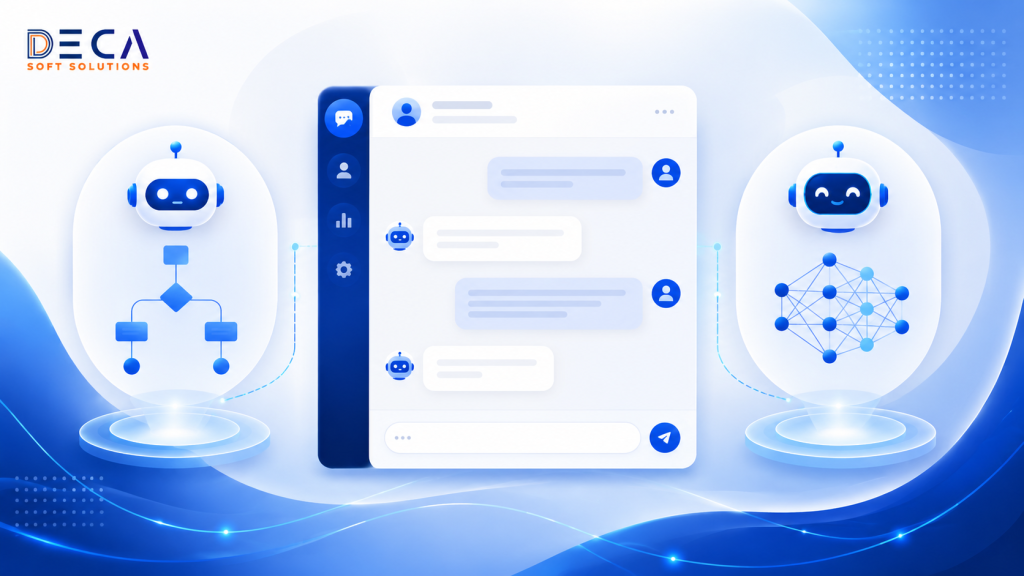
Most real-world deployments in 2026 do not fit neatly into either camp. A hybrid chatbot layers both technologies: scripted flows handle the high-frequency, well-defined queries (password resets, opening hours, order status), while an AI engine steps in for open-ended or complex conversations.
This architecture lets you control costs and risk on the tasks where predictability matters, while still delivering a natural experience for everything else.
Trigger → Action: User opens support chat → Rule-based menu presents three top categories → User selects “Billing” → AI module takes over to interpret the specific billing query, pulls account data via API, and responds in plain language.
Example: A SaaS platform deploys a hybrid bot via Intercom. The rule-based layer handles onboarding FAQs and routes trial-to-paid upgrade queries to the sales team. The AI layer handles everything else — feature questions, troubleshooting, and account management — and hands off to a human when sentiment turns negative.
Hybrid models are also an effective migration path. You can start with a rule-based foundation, instrument it to understand where users are getting stuck, and then introduce AI modules on the highest-friction paths first.
When to Choose Which Type
The right chatbot type is not a technology preference — it follows from your business requirements. Use the criteria below as a starting point.
5. Choose Rule-Based When:
- Your use case involves a small, stable set of questions with fixed answers.
- You are in a regulated industry where every response must be auditable and pre-approved.
- You need a working solution in days, not months.
- Your team lacks the data or machine learning expertise to train and govern an AI model.
6. Choose AI When:
- Users ask questions in highly varied ways and expect natural, context-aware replies.
- Your support volume is high enough that a more capable bot meaningfully reduces agent load.
- You need the bot to take actions across multiple back-end systems within a single conversation.
- You are already working with platforms such as UiPath or Microsoft Power Automate and want to extend automation into conversational channels.
7. Choose Hybrid When:
- You have both structured high-volume queries and open-ended conversations to handle.
- You want to start lean and expand AI coverage incrementally as your confidence and data grow.
- Your product catalogue, pricing, or policies change frequently — rule-based layers keep static content consistent while AI handles the variable parts.
Benefits of Getting This Decision Right
- Reduced support costs: Automating even a fraction of Tier-1 queries — password resets, FAQs, status checks — directly reduces headcount pressure on support teams.
- Faster response times: Customers receive instant replies around the clock, with no queue and no hold music.
- Consistent customer experience: A well-configured chatbot applies the same tone and accuracy across every interaction, eliminating the variability that comes with human agents under pressure.
- Higher agent productivity: When the chatbot handles routine queries, your human agents spend their time on the interactions that genuinely need empathy and judgment.
- Scalable growth: A hybrid or AI chatbot scales to handle seasonal peaks and international expansion without a proportional increase in headcount.
How to Get Started
A chatbot deployment that delivers measurable ROI does not begin with picking a platform — it begins with understanding what you are trying to solve.
- Audit your current support volume. Pull three months of tickets, chats, or call transcripts. Identify the top 20 query types by volume — these are your automation candidates.
- Classify by complexity. Tag each query type as structured (one or two fixed answers) or variable (requires context, judgment, or back-end data). Structured queries are your rule-based layer; variable ones may benefit from AI.
- Choose a platform that fits your stack. For workflow-heavy environments, tools like n8n, Zapier, or Make can connect your chatbot to the systems it needs to query or update. For enterprise-grade AI, consider UiPath, Power Automate, or Workato.
- Define your escalation path. Decide which query types should always route to a human agent, and make sure the handover is seamless — the agent should see the full conversation history.
- Instrument and iterate. Set up monitoring from day one: track containment rate (how many conversations complete without human escalation), customer satisfaction scores, and the specific points where conversations break down.
If you are exploring how AI fits into a broader automation strategy, our post on small language models and agentic AI efficiency covers complementary technologies worth considering alongside your chatbot deployment.
Frequently Asked Questions
What is the main difference between rule-based and AI chatbots?
Rule-based chatbots follow predefined scripts and respond only to inputs they have been explicitly programmed to recognise. AI chatbots use natural language processing and machine learning to interpret user intent, handle varied phrasing, and maintain context across a conversation — without needing every possible interaction mapped out in advance.
Are AI chatbots always the better choice?
Not always. AI chatbots offer more flexibility and personalisation, but they require greater investment in setup, data, and ongoing governance. For businesses with a narrow, well-defined set of support queries, a rule-based chatbot can deliver faster ROI at a fraction of the cost. The right choice depends on the complexity and variability of your specific use cases.
Can AI chatbots fully replace human support agents?
In most business contexts, AI chatbots are designed to complement rather than replace human agents. They handle high-volume, repetitive queries automatically and escalate complex or emotionally sensitive interactions to people. The most effective deployments treat the chatbot as the first line of response and the human agent as the escalation tier — each doing what they do best.
What is a hybrid chatbot, and should I consider one?
A hybrid chatbot combines rule-based flows for structured, predictable queries with AI capabilities for open-ended conversations. It is worth considering if your business has both types of interaction — the structured layer keeps costs and risks low, while the AI layer handles the variety. Hybrid models are also a practical migration path: you can start rule-based and layer in AI where it adds the most value.
How long does it take to deploy a chatbot?
A basic rule-based chatbot covering your top 10–15 query types can typically be live within one to two weeks, depending on integration complexity. An AI chatbot requires additional time for intent design, data preparation, and testing — realistic timelines range from four to twelve weeks for a production-ready deployment. A hybrid approach can fall in between, especially if you start with rule-based flows and extend AI coverage progressively.
Conclusion
In 2026, the chatbot landscape is more capable and more accessible than ever — but “more capable” does not mean “always more appropriate.” A well-configured rule-based bot can outperform a poorly governed AI chatbot on almost every metric that matters to your customers: speed, accuracy, and consistency.
The most important step is not choosing a technology — it is mapping your actual conversation data to the approach that fits it. Start with your support volume, classify by complexity, and build toward the architecture that solves the problem you actually have.
At Deca Soft Solutions, we help businesses design and deploy chatbot strategies that are practical, scalable, and aligned with real operational goals — whether that means a lean rule-based flow, a full AI solution, or a hybrid that bridges both. Talk to our team to find out which approach is the right fit for your business.