AI Agent Governance and Security: Building Trusted and Compliant Autonomous Systems
Key Takeaways
- AI agent governance is the framework for approving, controlling, and auditing autonomous AI systems across their full lifecycle — from use-case approval through to retirement.
- The EU AI Act, entering full effect in August 2026, requires high-risk AI systems to carry model cards, data lineage documentation, and continuous quality monitoring — not just policy statements.
- Permission boundaries define exactly what an agent may do and what data it may access, and are the most practical first control to implement in any agentic deployment.
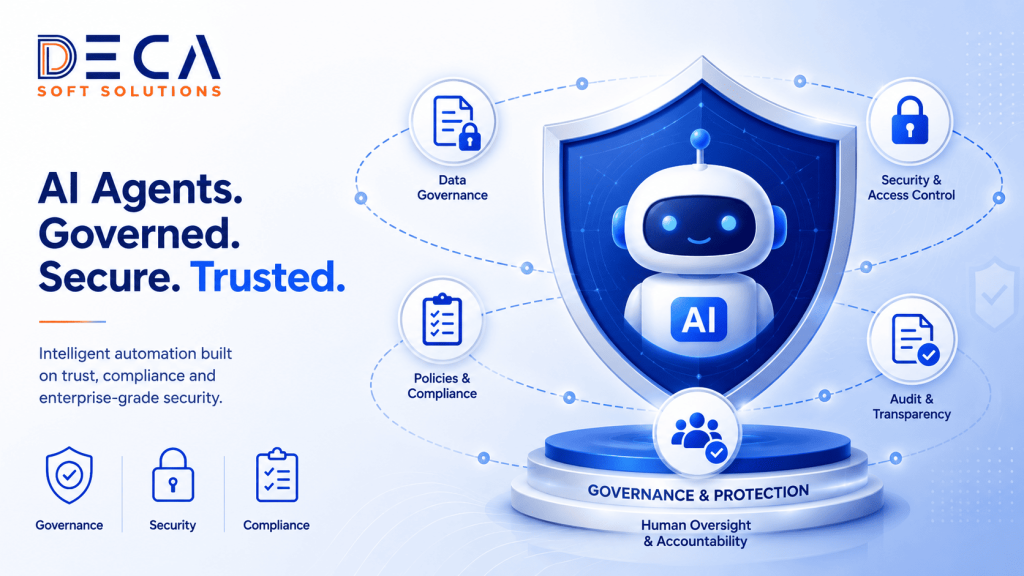
- Every governance-first architecture rests on five pillars: bounded autonomy, explainability, auditability, accountability, and continuous oversight.
- Governance measures should scale with risk — low-risk tasks can run autonomously with basic logging, while high-risk decisions require human approval checkpoints and detailed audit trails.
Introduction
The business case for autonomous AI agents is well established. They can compress days of analytical work into hours, handle high-volume repetitive processes without fatigue, and operate across multiple systems simultaneously. The governance case is catching up fast.
As AI agents take on more consequential tasks — approving financial transactions, influencing hiring decisions, recommending clinical actions — the question of how to control and audit their behaviour becomes a board-level concern, not just a technical one. Regulators have noticed. The EU AI Act, coming into full effect in August 2026, introduces legally binding requirements for documentation, explainability, and human oversight of high-risk AI systems. Similar frameworks are advancing in the United States, the United Kingdom, and across Asia-Pacific.
This guide gives you a practical framework for building AI agents that are genuinely trustworthy — not just in the sense of performing well on benchmarks, but in the sense that your regulators, auditors, and customers can verify the controls you have in place.
If you are new to agentic AI, our post on how autonomous AI agents are transforming business automation provides the foundation before you work through the governance layer covered here.
What Is AI Agent Governance?
AI agent governance is the operational framework that determines who can approve, deploy, and modify AI systems, what controls those systems must operate under, and what evidence the organisation must produce to demonstrate those controls are working.
It is worth distinguishing this from data governance, which most organisations already have in some form. Data governance covers how data is stored, accessed, and protected. AI governance extends further: it covers how models are trained, how they make decisions at inference time, how those decisions are logged and explained, and how the system is monitored and eventually retired. When a regulator or an internal auditor asks for evidence of AI controls, they are asking for the AI governance layer — not the data governance layer alone.
The practical demand for AI governance has sharpened because the gap between policy and proof is now a legal liability. Organisations operating in the EU can no longer rely on a governance policy document. They need enforceable controls, audit-ready logs, and documented model inventories to meet the requirements of the EU AI Act.
The Regulatory Landscape in 2026
Understanding what regulations apply to your AI deployments is the first step toward building compliant systems. The two most significant frameworks in 2026 are the EU AI Act and the NIST AI Risk Management Framework, with ISO/IEC 42001:2023 providing a complementary management systems standard.
1. EU AI Act
The EU AI Act classifies AI systems by risk level — minimal, limited, high, and prohibited — and sets proportionate obligations for each tier. High-risk systems (those used in employment, credit, healthcare, education, and critical infrastructure) face the most demanding requirements. These include mandatory model cards documenting intended use, performance metrics, and known limitations; data lineage records tracing the origin and transformation of training and inference data; continuous quality monitoring with documented baselines; and human oversight mechanisms that allow intervention in automated decisions.
For organisations exporting products or services into the EU, these requirements apply regardless of where the organisation is headquartered. Compliance is not optional — penalties for high-risk systems can reach up to 3% of global annual turnover.
2. NIST AI Risk Management Framework (AI RMF 1.0)
NIST’s AI RMF is a voluntary but widely adopted framework that organises AI risk management around four functions: Govern, Map, Measure, and Manage. Govern establishes the policies, roles, and accountability structures. Map identifies the context in which the AI system operates and the potential impacts on different stakeholders. Measure assesses the risks and performance characteristics of the system. Manage implements prioritised mitigations and tracks their effectiveness over time. For organisations in the United States, AI RMF alignment is increasingly cited by auditors and procurement teams as a baseline expectation.
3. ISO/IEC 42001:2023
ISO 42001 sets requirements for establishing, implementing, and maintaining an AI management system — the AI equivalent of ISO 27001 for information security. It covers organisational responsibilities, competence requirements, planning processes, operational controls, and performance evaluation. While certification is not mandatory in most jurisdictions, it provides a recognised signal of governance maturity to regulators, partners, and enterprise customers.
Principles of Governance-First Design
Governance-first design means building control mechanisms into your AI agent architecture at the design stage, rather than adding compliance workarounds after a deployment is already in production. Five principles underpin this approach.
2. Bounded Autonomy
Define explicitly what the agent is permitted to do and where it must stop and wait for a human. For routine, low-stakes tasks within well-defined parameters, the agent can act independently. For tasks that affect rights, finances, safety, or data privacy, it should require explicit approval before proceeding. The boundaries are not a constraint on the agent’s usefulness — they are the mechanism that makes the agent trustworthy enough to deploy in a regulated environment.
3. Explainability
Auditors and regulators are increasingly specific about this requirement: a governance policy that says “we use explainable AI” is not the same as a system that actually produces explanations. For high-risk decisions, the agent’s output should be accompanied by a rationale that a human reviewer can evaluate. Techniques such as SHAP (SHapley Additive exPlanations) and LIME (Local Interpretable Model-Agnostic Explanations) generate decision-level explanations for individual predictions and can be embedded in workflows that surface those explanations alongside outputs.
4. Auditability
Every consequential action the agent takes — every input it received, every model version it ran, every output it produced, every downstream system it updated — should be recorded in a tamper-evident log. These records are your primary evidence in a regulatory inquiry or an incident investigation. They also create the feedback loop you need to detect problems before they become liabilities.
5. Accountability
Governance frameworks require named owners, not just processes. Someone in your organisation needs to be responsible for approving each AI system, monitoring its ongoing performance, and making the call to retrain or retire it when circumstances change. That accountability structure should be documented and accessible to auditors on request.
6. Continuous Oversight
AI systems do not stay well-calibrated indefinitely. Data drift — where the statistical properties of incoming data diverge from the training distribution — and concept drift — where the relationship between inputs and correct outputs changes over time — can degrade performance without any obvious system failure. Governance-first architectures build monitoring into the deployment from day one and define the thresholds that trigger human review or model retraining.
Implementation Guide: Eight Steps to Bounded Autonomy
Turning these principles into a working system requires a combination of technical controls and organisational processes. The eight steps below apply across AI agent deployments of any scale.
Step 1 — Classify Tasks by Risk Level
Before you design any controls, map the tasks the agent will perform and assign each a risk tier. Low-risk tasks — information retrieval, internal report generation, content summarisation — can be fully automated with basic logging. Moderate-risk tasks — customer communications, inventory management, financial reporting — benefit from permission boundaries and periodic human review. High-risk tasks — loan approvals, hiring decisions, clinical recommendations, safety-critical actions — require human approval checkpoints at every consequential step.
This classification drives every subsequent design decision. Do not skip it in favour of building the workflow first.
Step 2 — Define Permission Boundaries
Permission boundaries are the most concrete governance control you can implement. They specify, at the system level, what actions the agent may take and which data it may access. A customer service agent might be permitted to read support tickets and update CRM records, but not to process refunds or access payment data without approval. Implement boundaries using fine-grained access controls at the API and database layer, and enforce them programmatically through policy-as-code tools so they cannot be bypassed by prompt manipulation.
Trigger → Action: Agent receives a refund request from a customer ticket → Checks its permission scope → Confirms refund processing is outside its approved permissions → Routes the request to a human approval queue → Logs the escalation with timestamp and ticket ID.
Step 3 — Build Decision Logs and Audit Trails
Configure the agent to record every action it takes: the input it received, the model version it used, the output it produced, the downstream systems it updated, and the timestamp of each event. Store these logs in tamper-evident, access-controlled storage and apply your organisation’s data retention policies. For regulated industries, retention periods are often mandated — check the applicable requirements before you configure your logging infrastructure.
Example: A financial services firm deploys an AI agent to screen credit applications. Every application processed by the agent generates a log entry recording the input data, the model’s risk score and rationale, the permission boundary checks applied, and whether the decision was auto-approved or escalated to a human underwriter. When a regulatory audit request arrives six months later, the compliance team can pull the complete decision history for any application in under two minutes.
Step 4 — Insert Human Approval Checkpoints
For high-risk decisions, the workflow should pause and require explicit human sign-off before the agent proceeds. Tools like n8n support manual approval nodes that hold execution until a named reviewer approves or rejects the pending action. The approval record — who approved it, when, and any notes they added — becomes part of the audit trail.
Trigger → Action: Hiring agent completes candidate screening and produces a ranked shortlist → Workflow pauses at an approval node → HR manager receives a notification with the shortlist and the agent’s scoring rationale → Manager approves, modifies, or rejects the shortlist → Agent proceeds to schedule interviews only after approval is recorded.
Step 5 — Embed Explainability Mechanisms
For decisions that affect individuals — credit, employment, healthcare — the agent’s output should include a plain-language explanation alongside the decision. This is both a regulatory requirement under the EU AI Act for high-risk systems and a practical necessity for human reviewers who need to validate the agent’s reasoning. Build explainability into the output schema at design time; retrofitting it after deployment is significantly more complex.
Step 6 — Set Up Continuous Monitoring
Define baseline performance metrics for each agent at deployment: accuracy, precision, recall, response latency, error rate, and any domain-specific metrics relevant to your use case. Configure automated dashboards and alerting to track deviations from these baselines in real time. Establish the thresholds that trigger a human review, a model retrain, or a temporary suspension of automated operation.
Step 7 — Maintain Model Inventories and Documentation
Keep a centralised registry of every AI model your organisation runs in production. For each entry, record the model version, training data sources, intended use, performance benchmarks, known limitations, approval date, and named owner. For high-risk systems under the EU AI Act, a formal model card meeting the Act’s documentation requirements is mandatory. Data lineage documentation — which tracks how training data was collected, cleaned, and transformed before reaching the model — should accompany each model card.
Step 8 — Adopt Policy-as-Code
Governance rules that exist only in Word documents are not enforced governance. Policy-as-code tools translate permission boundaries, approval requirements, and logging rules into machine-readable, version-controlled code that is tested and deployed alongside your AI workflows. When integrated with platforms like n8n, UiPath, or Workato, policy-as-code ensures that governance controls are applied consistently across every agent in your environment — not just the ones that were reviewed most recently.
For a deeper look at the open protocols that make multi-agent coordination and cross-system governance tractable, see our guide on MCP and A2A open standards for interoperable AI agents.
Continuous Monitoring and Audit in Practice
Governance does not end at go-live. Regulators and auditors increasingly expect organisations to demonstrate ongoing oversight, not a point-in-time review at deployment. Building a continuous monitoring practice requires four operational habits.
- Define baselines before you deploy. If you do not document what “normal” looks like at launch, you have no reference point for detecting drift later. Capture performance metrics, data distribution statistics, and decision distribution profiles on day one.
- Automate the monitoring layer. Human-reviewed dashboards checked weekly are not sufficient for high-volume or high-risk agents. Automated alerting that fires when a metric crosses a threshold gives you the earliest possible warning of degradation.
- Schedule periodic governance reviews. Beyond automated monitoring, schedule quarterly reviews of agent behaviour, documentation currency, and regulatory alignment. Regulations change; model performance changes; business requirements change. Governance frameworks need to keep pace with all three.
- Document remediation actions. When drift is detected and a model is retrained, or when a governance policy is updated, record the change — what triggered it, what was done, who approved it, and when. This documentation is itself a governance artefact that auditors will want to see.
Industry Use Cases
Governance requirements vary by industry and by the risk profile of the specific task. Here is how the framework applies across four common enterprise contexts.
9. Financial Services
Agents that assess loan applications, score credit risk, or flag suspicious transactions operate under some of the strictest AI governance requirements of any sector. Fair-lending regulations in many jurisdictions prohibit the use of certain sensitive attributes as direct inputs; permission boundaries must enforce this restriction at the data access layer, not just in the prompt. Human approval is required for any borderline decision that affects a customer’s access to credit, and full explainability records must be retained for the required regulatory period.
10. Healthcare
Diagnostic support agents, clinical decision aids, and patient triage systems must be configured to provide explainable recommendations and defer to clinicians for final decisions. Continuous monitoring is particularly important here — model performance can diverge across patient subgroups in ways that are not visible at the aggregate metric level. Governance controls should include subgroup performance monitoring and documented escalation paths for cases where the agent’s recommendation is overridden by a clinician.
11. Software Engineering and DevOps
Development agents that generate code, create pull requests, and run automated test suites are generally lower-risk than agents operating in regulated domains, but merge actions into production branches represent a meaningful risk boundary. The governance pattern here is straightforward: agents can propose and test; only a human reviewer can approve a merge to production. The PR review log — with the agent’s contribution and the human approver’s decision — serves as the audit trail.
12. Customer Support
Ticket triage, FAQ responses, and status updates are low-risk tasks that are well-suited to full automation with basic logging. Refund processing, account changes, and anything that involves financial or personal data transactions should sit behind a human approval checkpoint. The governance boundary in customer support is often the financial or data-access threshold — below a certain amount or sensitivity level, the agent acts; above it, it escalates.
Decision Framework: Governance Measures by Risk Level
| Risk Level | Example Tasks | Required Governance Measures |
|---|---|---|
| Low | Information retrieval, internal report generation, content summarisation | Automated execution; basic activity logging; standard performance monitoring |
| Moderate | Customer communications, inventory management, marketing personalisation | Permission boundaries; decision logs; periodic human review; basic output explainability |
| High | Credit approvals, hiring decisions, clinical recommendations, safety-critical operations | Strict permission boundaries; mandatory human approval checkpoints; detailed audit trails; full explainability; continuous monitoring; model cards and data lineage; regulatory framework compliance (EU AI Act, sector-specific regulations) |
Key Benefits of a Governance-First Approach
- Regulatory readiness: Organisations with governance controls already embedded can respond to regulatory inquiries and audits efficiently, rather than scrambling to reconstruct evidence after the fact.
- Reduced incident risk: Permission boundaries and human approval checkpoints prevent the class of errors that occur when an agent acts beyond its intended scope — errors that are often harder to remediate than to prevent.
- Faster enterprise adoption: Internal stakeholders and enterprise customers are significantly more willing to rely on AI agents that come with documented controls. Governance is a trust accelerator, not just a compliance burden.
- Operational visibility: Audit trails and monitoring dashboards generate the operational data you need to understand how agents are actually performing — which tasks they handle well, where they fall back to human review, and where performance is drifting.
- Sustainable scalability: Governance controls that are embedded in policy-as-code and workflow templates scale automatically as new agents are deployed. The alternative — manually reviewing governance for each new deployment — does not scale.
How to Get Started
The most common mistake organisations make with AI governance is waiting until they have a compliance problem to address it. By that point, the agent is already in production, the audit trail is incomplete, and the remediation cost is significantly higher than it would have been at design time.
A practical starting point is an AI inventory review: document every AI system currently in operation or in development, classify each by risk level using the framework above, and identify the gap between your current controls and what the risk level requires. That gap assessment tells you where to focus your governance effort first.
- Conduct an AI inventory audit. List every model, agent, or AI-assisted process your organisation runs. Capture the use case, the data it accesses, the decisions it influences, and who owns it.
- Apply the risk classification framework. Assign each system a risk tier. Focus initial governance investment on your high-risk systems — these are the ones most likely to attract regulatory scrutiny and the ones where an uncontrolled failure causes the most harm.
- Implement permission boundaries and logging first. These two controls are the highest-impact, lowest-complexity governance measures available. They can be retrofitted to existing deployments and built into new ones from day one.
- Build your model inventory. Create and maintain a centralised registry. For high-risk systems, start drafting model cards now — do not wait for a regulatory request.
- Establish a governance review cadence. Assign ownership, schedule quarterly reviews, and define the escalation path when a monitoring alert fires. Governance without a review cadence is governance in name only.
Frequently Asked Questions
What is the difference between AI governance and data governance?
Data governance focuses on how data is stored, accessed, and protected. AI governance extends across the full AI lifecycle: how models are trained, how they make decisions at inference time, how those decisions are logged and explained, and how systems are monitored and eventually retired. In practice, AI governance builds on top of data governance — it assumes that your data controls are in place and adds the additional layer of controls specific to automated decision-making.
Why are regulators focusing on AI governance now?
As autonomous AI systems take on more consequential tasks — influencing hiring, credit, healthcare, and public safety decisions — the potential harm from uncontrolled systems grows proportionally. Regulators have responded by requiring documented controls, not just policies. The EU AI Act, entering full effect in August 2026, is the most comprehensive example: it sets legally binding obligations for high-risk AI systems, with penalties of up to 3% of global annual turnover for non-compliance. Other jurisdictions are following with their own frameworks.
What are permission boundaries in AI agents?
Permission boundaries are explicit rules that define what an AI agent is allowed to do and what data it is allowed to access. They are implemented at the system level — in API access controls, database permissions, and policy-as-code frameworks — so they cannot be overridden by the agent’s own reasoning or by a manipulated prompt. A typical permission boundary might specify that a customer service agent can read tickets and update status fields, but cannot process refunds or access payment records without a human approval step.
How do model cards and data lineage support governance?
A model card is a structured document that records a model’s architecture, intended use, performance metrics, known limitations, and risks. Data lineage documentation traces the origin, transformation, and usage of the data that trained and runs the model. Together, they provide auditors and regulators with the evidence they need to verify that an AI system was built responsibly, is being used within its intended scope, and has the controls in place to catch problems. Under the EU AI Act, both are mandatory documentation requirements for high-risk AI systems.
What tools can help implement AI governance controls?
Policy-as-code frameworks — such as Open Policy Agent (OPA) — enforce permission boundaries programmatically and integrate with API gateways and workflow platforms. Workflow tools like n8n support manual approval nodes that pause automation pending human sign-off, and log each approval as part of the audit trail. Monitoring platforms track model drift, performance degradation, and anomalous behaviour in real time. A complete governance implementation combines all three layers: programmatic enforcement, human checkpoints, and continuous monitoring — with a centralised model inventory tying them together.
Conclusion
AI agent governance is no longer a forward-looking concern — it is an operational requirement for any organisation deploying autonomous systems in 2026. The EU AI Act, NIST AI RMF, and ISO/IEC 42001 provide the frameworks; the question is whether your deployments are built to meet them from the inside out, or whether compliance is being bolted on after the fact.
The organisations that get this right build governance into the architecture at design time — permission boundaries embedded in the API layer, audit trails generated automatically, human approval checkpoints wired into the workflow, and a monitoring cadence that treats governance as an ongoing operational practice rather than a one-time compliance exercise. That approach does not slow down AI adoption. It makes AI adoption sustainable at scale.
At Deca Soft Solutions, we help organisations design and deploy AI agent architectures that are secure, compliant, and audit-ready — across financial services, healthcare, DevOps, and enterprise operations. If you want to assess your current governance posture or build governance controls into an upcoming deployment, speak to our team to get started.