Claude Fable 5: Capabilities, Safety Mechanisms & Enterprise Use Cases

Key Takeaways
- Claude Fable 5 is Anthropic’s first publicly available Mythos-class model, launched on 9 June 2026 — sitting above the Opus family in capability.
- It offers a 1 million-token context window and up to 128k output tokens, making it purpose-built for long-horizon, multi-step tasks.
- Safety classifiers block high-risk prompts in areas like cybersecurity and biology, automatically falling back to Claude Opus 4.8 — at Opus pricing — in fewer than 5% of sessions.
- Pricing is $10 per million input tokens and $50 per million output tokens, with a 90% discount available through prompt caching.
- Fable 5 leads industry benchmarks in software engineering, knowledge work, vision tasks, and long-context reasoning — with practical enterprise applications in DevOps, financial services, and document automation.
Introduction
For months, Anthropic’s Mythos-class models existed only as a restricted capability — available to a handful of vetted organisations through Project Glasswing, and known primarily for their unprecedented ability to identify software vulnerabilities. On 9 June 2026, that changed. Anthropic released Claude Fable 5: the first Mythos-class model made safe for general use, available through the Claude API, AWS Bedrock, Google Vertex AI, and Microsoft Foundry.
The name is deliberate. Fable comes from the Latin fabula — “that which is told” — and it reflects the model’s strengths in reasoning, narrative-level comprehension, and sustained autonomous work. If your team has been exploring what frontier AI can genuinely do for complex, long-running business tasks, Fable 5 is the most capable answer Anthropic has made broadly accessible.
This guide covers what Fable 5 is, how it performs, what the safety architecture means for your workflows, and where it fits — or doesn’t — in an enterprise automation stack.
What Is Claude Fable 5?
Claude Fable 5 sits at the top of Anthropic’s public model lineup. The Mythos class represents a tier above Opus — designed not for fast, single-turn queries, but for ambitious, multi-step tasks that require sustained reasoning, context retention, and autonomous decision-making over extended sessions.
Fable 5 shares its underlying model weights with Claude Mythos 5, which remains restricted to vetted cyber defenders and infrastructure providers through Project Glasswing. The difference is in the safety layer: Claude Fable 5 includes classifiers that block responses in high-risk domains, making it suitable for broad deployment without the governance overhead that Mythos 5 demands.
Key Specifications
| Specification | Claude Fable 5 | Claude Opus 4.8 |
|---|---|---|
| Model Class | Mythos-class (above Opus) | Opus-class |
| Context Window | 1,000,000 tokens | ~200,000 tokens |
| Max Output | 128,000 tokens | ~32,000 tokens |
| Input Pricing | $10 / million tokens | $5 / million tokens |
| Output Pricing | $50 / million tokens | $25 / million tokens |
| Launch Date | 9 June 2026 | May 2026 |
| API Model String | claude-fable-5 | claude-opus-4-8 |
| Availability | Claude API, AWS Bedrock, Google Vertex AI, Microsoft Foundry | Same platforms |
| Safety Classifiers | Enabled — fallback to Opus 4.8 on trigger | Standard guardrails, no fallback routing |
How Does Fable 5 Perform? Benchmarks and Real-World Results
Benchmark performance tells part of the story; what Anthropic’s early enterprise testers reported tells the rest.
1. Software Engineering
On SWE-Bench Pro — a widely used agentic coding benchmark — Claude Fable 5 achieves an 80.3% pass rate. That is an 11-point lead over Opus 4.8 (69.2%) and a substantial gap ahead of GPT-5.5 (58.6%). On Cognition’s FrontierCode (Diamond) evaluation, which measures whether models can produce production-quality code under real constraints, Fable 5 scores 29.3% — more than double Opus 4.8’s 13.4%.
In practice, Stripe reported that Claude Fable 5 performed a codebase-wide migration across a 50-million-line Ruby repository in a single day — a task their engineering team had estimated would take over two months manually.
2. Knowledge Work and Financial Reasoning
On Hebbia’s Finance Benchmark for senior-level analytical reasoning, Fable 5 tops all models tested. IMC, the trading firm, noted that Fable 5 performed near-perfectly across their evaluation suite — including factual lookup, root-cause analysis, and expected-value reasoning. For teams in financial services, this translates directly into faster document analysis, more accurate scenario modelling, and reduced reliance on manual review cycles.
3. Vision and Multimodal Tasks
Fable 5 can extract precise values from complex scientific figures, rebuild a web application’s source code from screenshots alone, and complete tasks like playing Pokémon FireRed using raw visual input — without any of the external scaffolding that earlier models required. On GDP.pdf, a document reasoning benchmark that prohibits external tools, Claude Fable 5 leads at 29.8%, ahead of GPT-5.5 (24.9%), Opus 4.8 (22.5%), and Gemini 3.1 Pro (16.7%).
4. Memory and Long-Context Reasoning
The 1 million-token context window is not just a headline number — Fable 5 actually uses it. When given persistent file-based memory, its performance in sustained autonomous tasks improves three times more than Opus 4.8 under equivalent conditions. It also self-validates its outputs and stays on task longer, which matters enormously for agentic workflows where a model must operate with minimal human checkpoints.
If you are building or evaluating agentic automation architectures, our post on harnessing agentic AI for business automation covers how these long-horizon capabilities fit into a broader deployment strategy.
Safety Mechanisms and the Fallback Architecture
Releasing a Mythos-class model publicly required Anthropic to solve a genuine problem: how do you make a model this capable available to everyone without enabling serious misuse in domains like cybersecurity, synthetic biology, or chemical engineering?
Their answer is a conservative classifier layer built into Claude Fable 5. When a prompt triggers one of these classifiers, two things happen: the request is silently routed to Claude Opus 4.8, and you are billed at Opus rates rather than Fable rates. Anthropic stress-tested these classifiers with over 1,000 hours of external bug bounty attempts before launch, with no universal jailbreaks discovered.
What This Means in Practice
- Trigger rate: Classifiers activate in fewer than 5% of sessions on average, so the vast majority of enterprise use cases run entirely on Fable 5’s full capability.
- Billing protection: Rerouted requests are billed at Opus 4.8 rates. You will not pay Fable pricing for a response the fallback model generated.
- Data retention: Anthropic requires a 30-day data retention window for Mythos-class traffic, used solely for safety monitoring. Your API configuration and data governance policies need to account for this requirement before production deployment.
- Fallback API: Anthropic requires API customers to configure a fallback endpoint. This is not optional — it is part of the deployment contract for Fable 5 usage.
For most enterprise use cases — code migration, document processing, financial analysis, workflow orchestration — the classifier layer is essentially invisible. Where it becomes a planning consideration is in domains that touch cybersecurity research, biology, or chemical engineering, where some queries may receive Opus-level responses rather than Fable-level ones.
Enterprise Use Cases
Fable 5’s combination of deep reasoning, vision capabilities, and massive context window opens up automation scenarios that were not practical with previous models. Below are four areas where Deca Soft Solutions is actively helping clients evaluate and implement Fable 5 workflows.
5. Software Engineering and DevOps
The Stripe example is the clearest signal: Fable 5 can compress months of engineering work into days on large-scale code migrations. For enterprises sitting on legacy codebases — Ruby, Java, COBOL — the model can generate migration plans, rewrite code to new frameworks, refactor for performance, and validate the output, all within a single orchestrated workflow.
Trigger → Action: n8n fetches legacy code files from a repository → Sends batches to Fable 5 via the Claude API → Fable 5 rewrites and documents the code → n8n commits the output and triggers automated tests → Results are logged to a project management dashboard.
Example: A financial services firm uses this pipeline to migrate a Java-based transaction processing system to a modern microservices architecture. What previously required a six-month engagement is completed in four weeks, with Fable 5 handling the bulk of the translation and the engineering team focusing on review and edge-case validation.
6. Financial Analysis and Knowledge Work
Fable 5’s lead on Hebbia’s Finance Benchmark is not accidental — the model was built for the kind of multi-document, cross-referencing analytical work that characterises senior finance roles. Banks and asset managers can deploy it to process earnings calls, generate scenario models, extract covenant conditions from loan agreements, or produce board-ready summaries from raw research.
Trigger → Action: User uploads a batch of annual reports → UiPath captures and pre-processes the documents → Claude Fable 5 performs cross-document reasoning and extracts structured data → Output is pushed to a CRM or analytics dashboard → Analyst reviews and approves before distribution.
Example: A private equity team uses a Fable 5 workflow to analyse 40 target company reports each quarter. The model extracts EBITDA trends, flags covenant risks, and produces a ranked shortlist — a process that previously took the team two weeks now takes two days.
7. Vision-Driven Document Processing
Fable 5 can read scanned contracts, invoices, technical drawings, and forms without requiring pre-processing to extract structured text. It interprets layout, tables, and charts directly — then cross-checks extracted data against compliance rules or master data records.
Trigger → Action: Scanned invoice arrives via email → Power Automate captures the attachment → Fable 5 reads the document visually, extracts line items, and validates against purchase orders → Matched invoices are approved automatically; exceptions are flagged for human review.
Example: A manufacturing business processes 3,000 supplier invoices per month. After deploying a Fable 5 vision pipeline, straight-through processing increases from 60% to 91%, and the accounts payable team redirects their time to exception handling and supplier relationship management.
8. Agentic AI Orchestration
Fable 5’s long-context memory and self-validation capabilities make it a strong reasoning layer in multi-agent architectures — where one agent handles knowledge retrieval, Fable 5 performs the reasoning, and an RPA layer executes the resulting actions. This mirrors the agentic coordination patterns emerging across enterprise automation platforms.
For organisations already working with n8n, Make, or Workato, Fable 5 slots in as a reasoning node — taking structured inputs from earlier workflow steps, producing structured outputs, and handing off to execution layers. Our article on small language models and agentic AI efficiency explores how different model tiers can be combined for cost-effective multi-agent workflows.
Integration and Deployment Guide
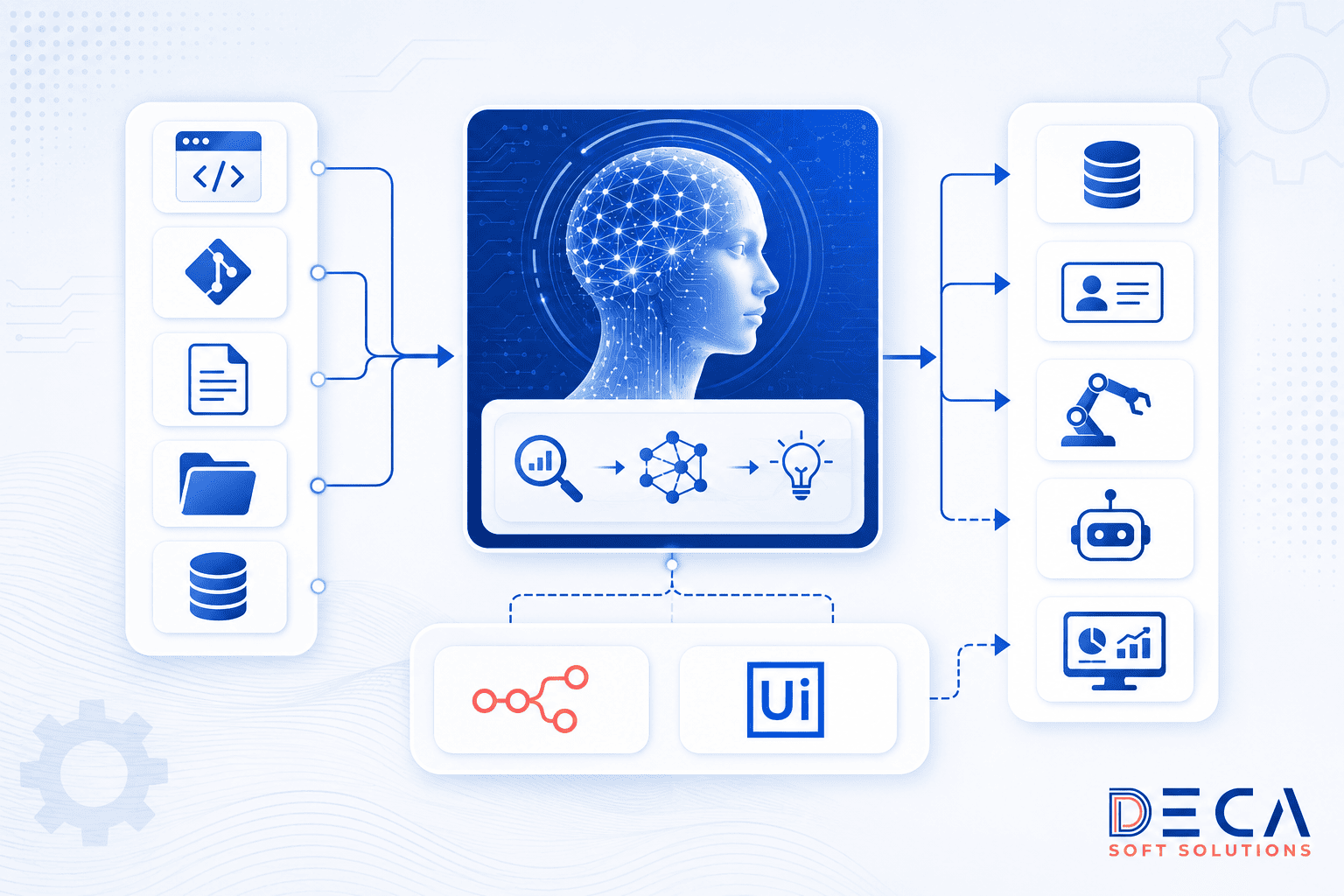
Deploying Fable 5 effectively requires more than API access. Here is a practical four-step framework your team can follow.
Step 1 — Choose Your Access Channel
Fable 5 is available via the Claude API (model string: claude-fable-5), AWS Bedrock, Google Vertex AI, and Microsoft Foundry. Select the channel that aligns with your existing cloud infrastructure and data residency requirements. For subscription users, Anthropic is including Fable 5 on Pro, Max, Team, and seat-based Enterprise plans at no extra cost through 22 June 2026; after that date, consumption credits apply.
Step 2 — Plan for Safe Deployment
Before writing a single line of integration code, map your use cases against the classifier domains. Tasks in cybersecurity research, synthetic biology, or chemical design will trigger the fallback to Opus 4.8 — that is expected behaviour, not an error. Configure your fallback API endpoint as Anthropic requires. Also review your data governance policies against the 30-day retention requirement for Mythos-class traffic and confirm compliance with your legal and privacy teams.
Step 3 — Design the Workflow
Fable 5’s value compounds when it is embedded in a well-structured automation workflow rather than used as a standalone prompt interface. Tools like n8n, Workato, and UiPath let you build workflows that feed prepared inputs to Fable 5, parse its structured outputs, and trigger downstream actions automatically.
- Code migration flow: Fetch files from a version control system → send to Fable 5 → parse refactored output → commit and run tests.
- Document analysis pipeline: Capture documents from email or ERP → send to Fable 5 for extraction and compliance check → push structured results to CRM or analytics platform.
- Multi-agent coordination: Retrieval agent gathers context → Fable 5 reasons and plans → RPA agent executes — all coordinated via MCP or A2A protocols.
Step 4 — Monitor Costs and Performance
Because Fable 5 is priced at a premium, cost visibility is not optional — it is part of responsible deployment. Implement token usage tracking from day one. Use prompt caching to take advantage of the 90% input discount on repeated context. Regularly review your task portfolio to confirm that Fable-level capability is genuinely needed, or whether Opus 4.8 or a smaller model would deliver equivalent results at lower cost. Deca Soft Solutions can help you build dashboards that track per-workflow token spend, fallback rates, and time-to-completion alongside your existing RPA and automation metrics.
Which Model Should You Use?
Fable 5 is not the right answer for every task. Use the framework below to guide your model selection decisions.
| Criteria | Choose Fable 5 | Choose Opus 4.8 | Choose Sonnet / Haiku |
|---|---|---|---|
| Task complexity | Multi-day, multi-step; large code migrations; long research projects | Medium complexity; standard code generation; moderate context | Simple Q&A; short summaries; routine automations |
| Risk domain | General domains outside cybersecurity / biology (fallback applies) | Broader domains without classifier restrictions | Low-risk, predictable tasks |
| Budget | Premium; high ROI where tasks would otherwise span months | Moderate; cost-effective for standard workloads | Low cost; high-volume, simple tasks |
| Context requirements | Millions of tokens; cross-document reasoning; persistent memory | Hundreds of thousands of tokens | Short context windows |
| Vision and multimodal | Complex vision — rebuilding apps from screenshots, scientific figure analysis | Basic image interpretation | Text only |
Key Benefits of Deploying Claude Fable 5
- Compressed timelines on complex tasks: Work that previously required weeks or months of engineering effort can be accomplished in days when Fable 5 is properly integrated into your automation stack.
- Reduced scaffolding requirements: Unlike earlier frontier models, Fable 5 performs advanced vision and reasoning tasks with minimal external tooling — which lowers integration complexity and maintenance overhead.
- Built-in cost protection: The fallback mechanism ensures you only pay Fable pricing when you are actually receiving Fable-level output. Safety-triggered responses are charged at Opus rates.
- Benchmark-leading accuracy on knowledge work: For teams in finance, legal, or research where output quality directly affects decisions, Fable 5’s lead on analytical benchmarks translates into fewer errors and less time spent on manual validation.
- Scalable agentic foundation: With a 1 million-token context window and strong self-validation behaviour, Fable 5 is a genuinely capable reasoning core for multi-agent architectures that need to operate autonomously over extended periods.
Frequently Asked Questions
What distinguishes Claude Fable 5 from Claude Mythos 5?
Both models share the same underlying weights, but Fable 5 includes safety classifiers that block responses in high-risk domains — cybersecurity, biology, and chemistry — automatically routing those queries to Claude Opus 4.8 instead. Mythos 5 operates without those classifiers and is currently available only to vetted organisations through Anthropic’s Project Glasswing. Fable 5 is the general-purpose, publicly accessible version of the same Mythos-class capability.
How much does Claude Fable 5 cost?
Fable 5 is priced at $10 per million input tokens and $50 per million output tokens — less than half the cost of the previous Claude Mythos Preview. Prompt caching provides a 90% input discount on repeated context, and any requests routed to the Opus 4.8 fallback are billed at Opus rates rather than Fable rates. For subscription users, Fable 5 is included at no extra cost through 22 June 2026.
Does Claude Fable 5 support multimodal inputs?
Yes. Fable 5 accepts text, images, and files through the Claude API. Its vision capabilities allow it to interpret diagrams, tables, scientific figures, and screenshots directly — including complex tasks like rebuilding a web application’s source code from a visual screenshot alone, without any intermediate OCR or text extraction step.
How does the fallback mechanism affect billing?
When a query triggers Fable 5’s safety classifier, the request is rerouted to Claude Opus 4.8 and billed at the lower Opus pricing — not at Fable rates. If the safety classifier blocks the response entirely before any output is generated, the request is not billed at all. This means your cost exposure on classifier-triggered sessions is lower than a standard Fable 5 call, not higher.
Is Claude Fable 5 suitable for sensitive research?
It depends on the domain. For most research workloads — literature synthesis, data analysis, hypothesis generation in non-restricted areas — Fable 5 is highly capable and generally available. For research in cybersecurity, synthetic biology, or chemical engineering, the safety classifiers will route some queries to Opus 4.8. Organisations requiring unfiltered access to the full Mythos capability set can apply to Anthropic’s trusted access programme for consideration under Project Glasswing.
Conclusion
Claude Fable 5 represents a genuine step change in what publicly available AI models can do. The gap in performance on software engineering, financial reasoning, and vision tasks is not incremental — it is the difference between a model that assists and a model that executes. For teams with complex, long-horizon automation challenges, Fable 5 is the most capable tool Anthropic has made broadly accessible.
That capability comes with planning requirements: fallback API configuration, data retention governance, cost tracking, and a clear view of which tasks genuinely justify Mythos-class performance versus what Opus 4.8 handles equally well. Getting that balance right is where the ROI lives.
Deca Soft Solutions is already working with clients to evaluate, pilot, and integrate Fable 5 into production automation workflows — across DevOps, financial services, and document processing. If you want to understand how Fable 5 fits into your specific stack and use cases, speak to our team to get started.