Agentic Commerce: AI Shopping Agents Transforming E-Commerce
Key Takeaways
- Agentic commerce describes autonomous AI agents that discover products, compare options, check availability, and complete purchases on a consumer’s behalf — end to end, without manual input at each step.
- Consumer readiness is already there: according to a Commercetools study, 73% of consumers use AI somewhere in their shopping journey today, and 70% are comfortable letting an AI agent make a purchase for them.
- The gap between comfort and action is the biggest opportunity: only 13% of consumers have actually completed a purchase via an AI assistant — meaning the conversion infrastructure, not the demand, is the bottleneck.
- Open protocols — Universal Commerce Protocol (UCP), Agentic Commerce Protocol (ACP), and Model Context Protocol (MCP) — are the interoperability layer that makes multi-merchant, multi-agent commerce viable.
- Security is the defining challenge: AI agents mimic legitimate customer behaviour, making traditional bot defences ineffective. Intent-based bot management and cryptographic agent authentication are the new baseline.
Introduction
The way people shop online has been changing incrementally for two decades — better search, smarter recommendations, faster checkout. Agentic commerce is not an incremental change. It is a structural one.
Instead of a consumer visiting a website, searching for a product, reading reviews, comparing prices, and completing a checkout, an AI agent does all of that on their behalf. The consumer states what they want — a birthday gift for a ten-year-old who likes science, under £40, delivered by Friday — and the agent handles the rest: searching across merchants, reading reviews, checking stock and delivery times, and placing the order.
In 2026, this is no longer speculative. Major platforms — Google, OpenAI, Perplexity — have all shipped early agentic shopping features. Analysts at Morgan Stanley project that by 2030 nearly half of all online shoppers will use AI agents regularly, and that those agents could mediate roughly a quarter of their total online spending. The global market opportunity associated with agentic commerce is estimated at as much as $5 trillion by the end of this decade.
For retailers, this shift changes the rules of visibility, conversion, and customer trust simultaneously. This guide covers what agentic commerce is, why it is breaking through now, what the data shows about consumer behaviour, how the underlying protocols and infrastructure work, what security demands it places on businesses, and how to prepare your operation for a world where your most important “customer” may be an AI agent.
What Is Agentic Commerce?
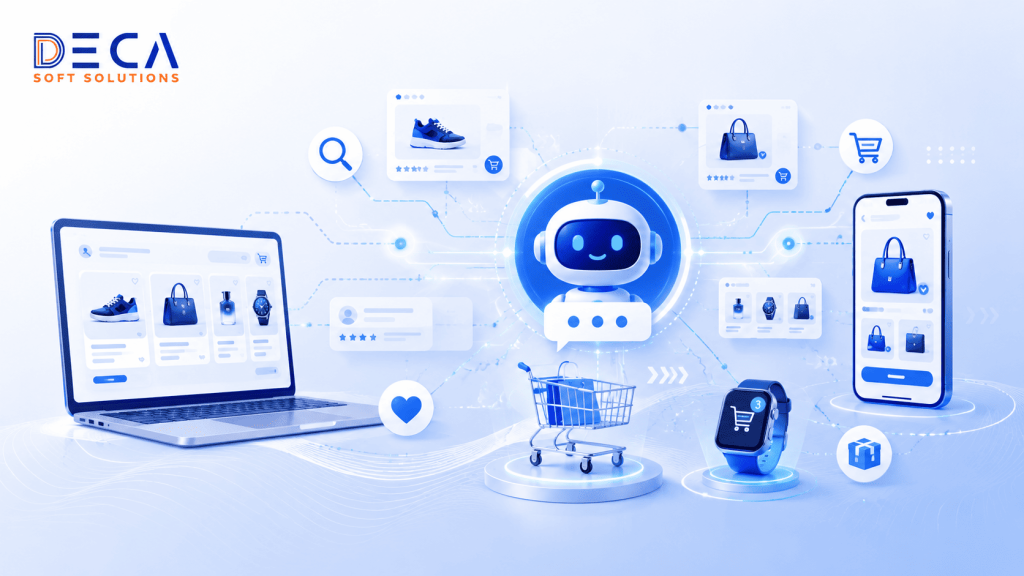
Agentic commerce is e-commerce mediated by autonomous AI agents. Where a conventional AI recommendation engine suggests products and waits for the consumer to act, an agentic system carries out the entire transaction lifecycle on the consumer’s behalf.
A fully capable AI shopping agent can:
- Discover products by searching web catalogues, comparing listings across multiple merchants, and filtering by the consumer’s stated preferences and constraints.
- Evaluate options by reading and synthesising product specifications, customer reviews, and expert opinions — producing a reasoned comparison rather than a ranked list of search results.
- Check real-time availability and pricing across merchants, including stock levels, shipping timelines, and applicable promotions.
- Initiate and complete checkout via a merchant’s website, mobile app, or API — handling payment authorisation, address selection, and order confirmation without the consumer touching each step.
- Manage post-purchase tasks including order tracking, return initiation, and proactive reordering of consumables when stock runs low.
These agents are built on large language models combined with tool use, persistent memory, and reasoning capabilities that allow them to interpret natural language goals, plan multi-step tasks, interact with web interfaces, and take real-world actions. McKinsey has described the transition toward AI-mediated shopping as a “seismic shift” in how commerce operates — not because the technology is new, but because the combination of capable models, consumer readiness, and emerging interoperability standards has brought it to a tipping point simultaneously.
Why 2026 Is the Breakout Year for Agentic Commerce
Several independent forces have converged in 2026 to move agentic commerce from pilot projects into early mainstream deployment. Understanding these forces helps you assess how quickly your own category is likely to be affected.
1. Consumer Readiness Has Crossed a Threshold
Consumer comfort with AI in the shopping journey has grown significantly faster than most retail analysts anticipated. A study cited by Commercetools found that 73% of consumers already use AI tools at some point in their shopping process — primarily for generating product ideas, summarising reviews, and comparing prices. Among Gen Z, more than half use AI specifically for product discovery. Crucially, 70% of consumers say they are at least somewhat comfortable letting an AI agent make a purchase on their behalf.
The gap between comfort and actual AI-driven purchasing (currently 13% who have completed a purchase via an AI assistant) is not a demand problem — it is an infrastructure and trust problem. The demand is there. The friction is in the checkout layer, not in the consumer’s willingness.
2. Language Models Are Now Capable Enough
The current generation of frontier models — including Claude Fable 5, GPT-5 mini, and Gemini 3 — can understand complex, multi-constraint shopping requests, maintain context across long research conversations, access real-time data through tool integrations, and produce personalised recommendations that reflect individual preferences rather than population-level averages. These capabilities make the difference between an AI assistant that helps you find products and an agent that genuinely replaces the need for you to do the finding yourself.
3. Interoperability Standards Are Emerging
The missing piece that has historically blocked agentic commerce at scale is the lack of common protocols for agents to communicate with merchants, payment systems, and logistics providers. That gap is closing. The Universal Commerce Protocol and Agentic Commerce Protocol are establishing the shared language that allows AI agents from different vendors to discover products, negotiate terms, and complete transactions across different merchant systems — without requiring a custom integration for each retailer.
Market Outlook: What the Data Shows
The statistics around agentic commerce in 2026 reveal a market in the early phase of a significant adoption curve — with strong consumer intent, meaningful hesitancy, and impressive early performance signals where agentic features have been deployed.
| Metric | Data Point | Source |
|---|---|---|
| Consumers using AI for shopping research | 65% have used AI tools to research products; 32% do so weekly | Clutch 2026 survey |
| Comfort with AI-completed purchases | 70% are at least somewhat comfortable with an AI agent making a purchase on their behalf | Commercetools study |
| Actual AI-driven purchases completed | Only 13% have completed a purchase referred or initiated by an AI assistant | Commercetools study |
| Consumer concerns about AI shopping | 95% report at least one concern — data privacy (63%), brand bias (53%), and personal data misuse (52%) are the top three | Clutch 2026 survey |
| AI-driven purchases in the past month | 23% of American consumers made a purchase using AI in the last 30 days | Morgan Stanley |
| AI traffic growth to retail sites | AI-generated traffic to US retail sites increased 805% year-over-year during Black Friday 2025 | Adobe |
| Conversion rate advantage | AI-generated product recommendations convert 4.4× better than traditional search results | McKinsey |
| Long-range market projection | By 2030, AI agents could mediate approximately 25% of online consumer spending | Morgan Stanley |
The 805% growth in AI-driven retail traffic over a single Black Friday is perhaps the most striking signal. It is not a gradual trend — it is a step change. Retailers who are not indexed and accessible to AI agents are already experiencing reduced visibility, not just reduced conversion.
The Current State: Where Agentic Commerce Is Today
In 2026, most deployed agentic commerce capability is concentrated in the early stages of the purchase funnel — product discovery, research, and recommendation — rather than autonomous checkout. That is where the existing infrastructure is mature enough to support reliable agent operation. The deeper funnel — secure payment authorisation, tax handling, loyalty programme integration, and shipping logistics — remains the harder problem.
Three major platforms have shipped meaningful agentic shopping capabilities in the past twelve months:
- Perplexity launched a shopping experience that combines conversational product discovery with personalised product cards and integrated PayPal checkout — one of the first production examples of a research-to-purchase flow handled entirely within an AI interface.
- OpenAI added shopping research capabilities to ChatGPT, using reinforcement learning to generate comparative product guides with real-time feedback loops that improve recommendation quality over time.
- Google introduced agentic checkout through its search experience and Gemini, enabling agents to execute purchases directly on merchant sites via a “Buy for me” capability — the most direct example of full-funnel automation currently available to consumers at scale.
The pattern across all three is the same: start with research and discovery, then push progressively further into the checkout flow as merchant integration and consumer trust develop. Retailers who have optimised their product data and APIs for agent consumption are already seeing the 4.4× conversion advantage that McKinsey’s data describes. Those who have not are invisible to these new traffic sources.
Protocols and Infrastructure: The Invisible Plumbing
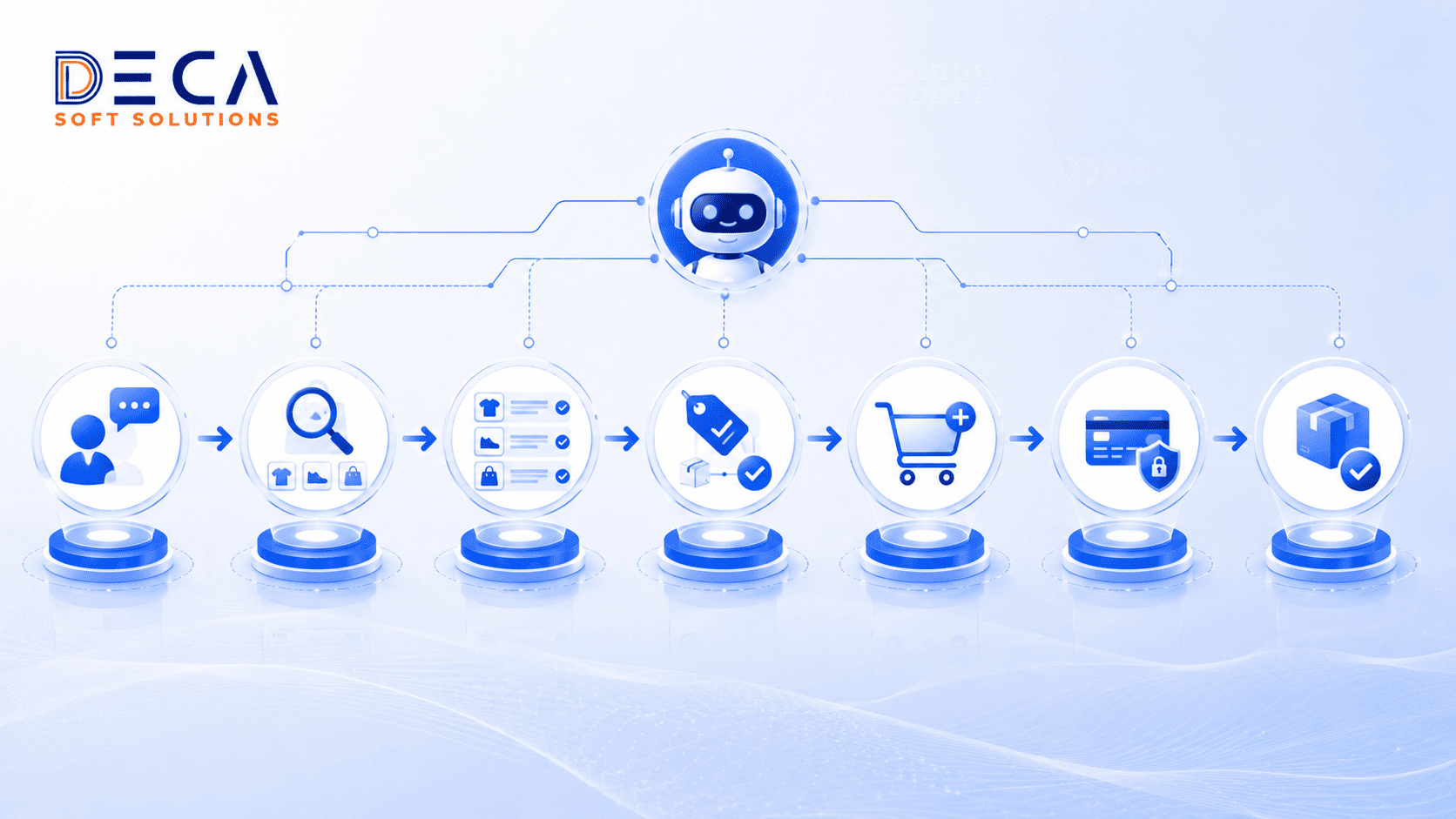
For AI agents to operate reliably across multiple merchants and payment systems, they need a common language. That is what the emerging agentic commerce protocols provide — and without them, every retailer-agent integration would require a bespoke build.
Universal Commerce Protocol (UCP)
The UCP is an open standard championed by Google and major retail partners that defines how AI agents communicate with commerce systems about product information, pricing, inventory status, and ordering details. It establishes a consistent data schema that allows agents from any platform to query a compliant merchant’s catalogue without needing to understand the merchant’s specific system architecture.
Agentic Commerce Protocol (ACP)
ACP extends UCP with agent-to-agent transaction support — the capability for AI agents representing different parties (a consumer’s shopping agent and a merchant’s fulfilment agent, for example) to negotiate and complete transactions autonomously. ACP roadmaps include multi-item cart management, subscription reorder support, and B2B procurement workflows, making it the foundational protocol for the full-journey automation that will define the next phase of agentic commerce.
Model Context Protocol (MCP)
MCP is the wider protocol layer that governs how LLMs call tools and maintain security across multi-tenant configurations. In the agentic commerce context, MCP is what allows a shopping agent to call a payment API, verify inventory in real time, or look up a consumer’s stored preferences — all with appropriate security boundaries and governance controls. Our guide on MCP and A2A open standards for interoperable AI agents covers this protocol layer in detail.
Infrastructure Requirements for Retailers
Protocol compliance alone is not sufficient. To be accessible to AI shopping agents, retailers need four infrastructure capabilities in place:
- Real-time inventory visibility — agents need current stock levels and delivery timelines, not batch-updated data that may be hours old.
- Standardised product data — rich, consistent metadata with complete specifications, attributes, and structured taxonomy enables agents to compare products across merchants accurately.
- Extensible APIs — headless commerce architecture that exposes cart, payment, and order management functions via API, not just via a browser interface.
- Secure authentication mechanisms — the ability to verify the identity of agents making requests and enforce per-agent permission scopes.
Security, Governance, and Trust
Security is both the most complex and the most commercially consequential challenge in agentic commerce. The problem is not that AI agents are inherently malicious — it is that they are indistinguishable from sophisticated bots, which are inherently malicious.
Traditional bot defences rely on detecting non-human patterns: inhuman click speeds, missing mouse movement data, predictable navigation paths. A well-built AI shopping agent exhibits none of these signals — it simulates human-like browsing behaviour convincingly enough to defeat most rule-based detection systems. Attackers exploiting this are already deploying AI-powered scrapers for card testing, inventory manipulation, and credential stuffing at a scale that conventional defences cannot match.
Intent-Based Bot Management
The next generation of bot detection moves from behavioural fingerprinting to intent analysis — assessing the full session trajectory to determine whether the agent’s goal is consistent with legitimate shopping behaviour. An agent that visits 40 product pages in 90 seconds, selects the cheapest item across all 40, and immediately proceeds to payment exhibits a pattern that differs from a legitimate bargain-hunting agent in measurable ways. Intent-based systems learn to distinguish these patterns without blocking legitimate agent traffic.
Cryptographic Agent Authentication
The proposed IETF Web Bot Auth standard provides a mechanism for AI agents to attach cryptographic signatures to their requests — effectively a verifiable credential that proves the agent’s identity and the platform it is operating on behalf of. For merchants, this enables a critical distinction: differentiate between a trusted consumer agent on a recognised platform and an unknown automated request, and apply different access rules to each.
Transaction-Level Controls
Multi-factor authentication, spend limits, and per-session permission scopes applied to agent-initiated transactions provide a defence-in-depth layer that limits the blast radius when a compromised session occurs. Agents should be provisioned with the minimum permissions needed to complete the task — read access for research phases, limited write access only for the checkout step — with additional verification required for high-value orders.
Governance and Transparency
Consumer trust in agentic commerce depends on transparency: knowing when an AI agent is acting on their behalf, being able to review and override agent decisions before they are executed, and having confidence that their personal data is being used only for the purpose they authorised. Retailers deploying agentic features need to build clear disclosure mechanisms, user-accessible audit logs of agent actions, and straightforward override controls into the consumer experience.
The governance design principles that apply to enterprise AI agents apply here equally. Our guide on AI agent governance and security for compliant autonomous systems covers permission boundaries, decision logging, and approval checkpoint design in detail.
Implementation Framework for Retailers
Adopting agentic commerce is not a single project — it is a phased capability build. The following framework helps you sequence the work based on your current readiness and risk tolerance.
| Dimension | Proceed When | Recommended Actions |
|---|---|---|
| Market readiness | Your customer base includes tech-savvy segments already using AI for product research and comparison | Survey your customer base; identify early adopter segments; pilot agentic discovery features with a defined cohort before broad rollout |
| Product complexity | Your catalogue includes products with multiple configuration options, comparable specifications, or high research value | Prioritise rich metadata and structured comparison data for your highest-consideration SKUs; these are the products agents will recommend first |
| Data quality | You have clean, comprehensive product data with real-time inventory and pricing feeds | Invest in a unified Product Information Management (PIM) system; standardise attribute taxonomy; ensure your inventory API reflects current stock, not batch-updated data |
| Security and compliance | You can implement intent-based bot management, agent authentication, and transaction-level controls | Evaluate modern bot detection platforms; adopt Web Bot Auth when available; integrate fraud monitoring with agent session data; document your governance policies and audit mechanisms |
| Platform integration | Your commerce platform supports dynamic agent interactions including add-to-cart and payment APIs | Move toward API-first, headless commerce architecture; ensure your stack can consume and expose UCP- and ACP-compliant data formats |
| Risk tolerance | You have defined order thresholds for autonomous agent transactions and can intervene when needed | Set value limits for agent-initiated purchases; require additional verification for high-value orders; maintain human-in-the-loop controls for your highest-risk transaction categories |
Trigger → Action: Customer sets up a recurring household essentials agent → Agent is provisioned with a spending limit and a list of approved product categories → Each week the agent checks current stock levels and prices across approved merchants → Selects the best-value option within defined parameters → Initiates checkout via the merchant’s API → Sends the consumer a summary for review → Executes payment after a 2-hour review window expires without override.
Example: A UK grocery retailer pilots an agentic reorder feature for their subscription customers. The agent monitors the customer’s previous purchase history, identifies items running low based on consumption patterns, finds the best current price including loyalty discounts, and places the order automatically with a 12-hour notification window for the customer to review or override. Early pilot results show a 34% increase in repeat purchase frequency and a significant reduction in customer service contacts related to running out of regularly purchased items.
Answer Engine Optimisation: The New SEO
As AI agents replace traditional web search for product discovery tasks, the optimisation discipline that determines whether your products appear in agent recommendations is changing. Search engine optimisation (SEO) — built around keyword matching and link authority — is being supplemented by answer engine optimisation (AEO): making your product content structured, accurate, and accessible enough that AI agents can confidently cite and recommend it.
The practical requirements of AEO for retailers include:
- Structured product data with complete schema markup, consistent attribute naming, and machine-readable specifications — not just natural language descriptions.
- Real-time pricing and availability accessible via API or structured feeds, so agents are never recommending based on stale data.
- Review and rating data exposed in a format agents can consume and summarise — not locked behind JavaScript rendering that agents may not execute.
- Clear return and shipping policies in structured, machine-readable formats that agents can surface to consumers during the comparison phase.
- API-accessible checkout — if your checkout can only be completed via a specific browser flow, agents cannot complete the transaction without browser automation, which is less reliable and more security-exposed than a direct API call.
Retailers that invest in AEO now are positioning themselves to capture the agent-mediated traffic that is growing at hundreds of percent annually. Those that do not are building a visibility gap that will be increasingly expensive to close as agent-driven commerce becomes the dominant channel for high-consideration purchases.
Future Trends
The agentic commerce landscape in 2026 is early-stage. The trajectory over the next three to five years points toward several significant developments.
- Full-journey automation will extend agent capability beyond the purchase step into post-purchase management — order tracking, return initiation, and proactive replenishment based on consumption data — creating a continuous agent relationship rather than a transactional one.
- B2B agentic commerce is likely to grow faster than consumer applications. Gartner projects that up to 90% of B2B buying interactions could be AI-mediated by 2030. Procurement agents negotiating terms, coordinating logistics, and optimising inventory across supplier networks represent a significantly larger aggregate transaction volume than consumer shopping agents, and the use case fits better with enterprise risk tolerance for autonomous action.
- Multi-agent orchestration — where a consumer’s personal shopping agent coordinates with a merchant’s inventory agent and a logistics provider’s fulfilment agent simultaneously — will require the ACP agent-to-agent transaction layer to be widely adopted, but once it is, the speed and efficiency advantages over conventional e-commerce will be substantial.
- New attribution models will be required. When an AI agent drives a purchase without the consumer visiting your website, standard web analytics provides no visibility into the interaction. Retailers will need to instrument agent touchpoints directly and work with AI platforms on anonymised data-sharing arrangements to maintain conversion attribution.
- Hybrid experiences will be the norm rather than the exception. Not every purchase category is equally suited to full autonomy. High-consideration, emotionally significant, or first-time purchases will retain human involvement for longer. Agentic commerce will be selective — deep where trust and value are established, light-touch where they are not.
Key Benefits for Retailers Who Move Now
- Early visibility advantage: AI agents currently recommend a relatively small pool of well-structured, API-accessible product catalogues. Retailers who make themselves discoverable and recommendable now are competing in a less crowded field than they will be in 18 months.
- Conversion uplift: AI-generated product recommendations convert 4.4× better than traditional search results, according to McKinsey’s data. The underlying reason is relevance — agents that understand context produce recommendations that match consumer intent more precisely than keyword-based search.
- Reduced friction: Removing the research and checkout burden from the consumer reduces the number of points at which purchase intent can dissipate. Agent-mediated purchases that go from intent to confirmation in minutes eliminate the abandonment risk that sits in every traditional checkout funnel.
- Post-purchase relationship: An agent that manages a consumer’s recurring purchases has a persistent relationship with that consumer’s needs — not a transactional one. Retailers embedded in that relationship benefit from predictable demand signals, lower reacquisition costs, and higher lifetime value.
- Operational efficiency: Agent-to-API commerce reduces the customer service overhead associated with search failures, checkout confusion, and order errors, because the agent handles the lookup, comparison, and selection steps more reliably than a consumer navigating a complex catalogue manually.
Frequently Asked Questions
What is agentic commerce?
Agentic commerce describes e-commerce mediated by autonomous AI agents that act on behalf of consumers to discover products, compare options across multiple merchants, check availability and pricing in real time, and execute purchases — completing the entire transaction lifecycle without requiring the consumer to manually interact with each step. It goes beyond AI-powered product recommendations by enabling the agent to take real-world actions, not just surface information.
How many consumers are already using AI for shopping?
According to a 2026 Clutch survey, 65% of consumers have used AI tools to research products, and 32% do so on a weekly basis. A Commercetools study found that 73% of consumers use AI at some point in their shopping journey, primarily for product discovery, review summarisation, and price comparison. Only 13% have completed a purchase via an AI assistant — but 70% say they are comfortable with an AI agent making a purchase on their behalf, indicating that infrastructure and trust, not consumer appetite, is the current constraint on wider adoption.
What are the main benefits of agentic commerce for retailers?
The primary benefits are conversion uplift, reduced checkout friction, and early channel visibility. AI-generated product recommendations convert 4.4 times better than traditional search results, according to McKinsey. Agent-mediated purchases compress the research-to-checkout cycle, reducing the abandonment risk embedded in every traditional funnel. Retailers who make their catalogues and checkout flows accessible to agents now are building visibility in a channel that is growing at hundreds of percent annually, while the competitive field is still relatively uncrowded.
What security risks does agentic commerce introduce?
The central security challenge is that AI shopping agents are behaviourally indistinguishable from sophisticated malicious bots — both simulate human-like browsing patterns, defeating traditional rule-based bot defences. Specific risks include card testing, inventory manipulation through artificial demand signals, credential stuffing using AI-generated credential variations, and synthetic identity fraud. Effective defences require intent-based bot management that analyses session trajectory rather than individual behaviour signals, cryptographic agent authentication using standards like the proposed IETF Web Bot Auth, and transaction-level controls including spend limits and per-session permission scopes for agent-initiated purchases.
How should retailers prepare for agentic commerce?
Preparation covers four areas. First, data quality: invest in a unified Product Information Management system with complete, standardised metadata and real-time inventory and pricing feeds — agents cannot recommend what they cannot accurately read. Second, technical infrastructure: move toward API-first, headless commerce architecture and ensure compatibility with emerging standards like UCP and ACP. Third, security: implement intent-based bot detection, agent authentication, and governance policies with documented audit trails. Fourth, optimisation: apply answer engine optimisation (AEO) principles to make your product content structured, accurate, and accessible enough for AI agents to confidently cite and recommend. Start with read-only agent interactions, validate performance, then extend to agentic checkout with human-in-the-loop controls for high-value transactions.
Conclusion
Agentic commerce is not a future scenario that retailers can defer planning for until the technology matures further. The technology is mature enough. The consumers are ready. The traffic is already arriving — AI-driven visits to US retail sites grew 805% in a single Black Friday cycle. The question is whether your operation is structured to capture it.
The retailers who will be best positioned when agent-mediated commerce becomes the dominant channel for high-consideration purchases are those who invest now in data quality, API accessibility, agent-compatible security controls, and AEO — not after the channel has consolidated around the players who moved first.
At Deca Soft Solutions, we help retailers and brands design and implement agentic commerce strategies that are secure, compliant, and built to scale — from product data standardisation and API architecture through to governance frameworks and agent integration. Contact our team to start your agentic commerce readiness assessment.