Edge AI and Real-Time Automation: 10 Benefits, Trends & Implementation Guide
Key Takeaways
- Edge AI runs AI models directly on local devices — sensors, cameras, robots — rather than sending data to the cloud, enabling decisions in milliseconds.
- Real-time automation built on edge AI allows systems to act instantly on streaming data, supporting use cases from quality control to patient monitoring.
- Small language models (SLMs) are making edge deployment more accessible: Gartner forecasts that organizations will use task-specific SLMs three times more often than large general models by 2027.
- Open standards — the Model Context Protocol (MCP) and Agent-to-Agent Protocol (A2A) — simplify how edge devices and cloud services share data and coordinate actions.
- A phased implementation roadmap — starting with high-value use cases, right-sizing models and applying robust security — is the fastest path to measurable ROI.
Introduction
Not all data can wait for the cloud. As the volume of machine, sensor and device data continues to grow, the cost and latency of routing everything to a remote data center is becoming a hard limit for businesses that need instant decisions. Edge AI solves this by deploying AI models on the devices themselves — embedded chips, industrial cameras, robots — where data is generated. Real-time automation takes that a step further: once a model reaches a conclusion locally, the system acts on it immediately, without waiting for a network round trip.
This shift is accelerating. Analysts point to 2026 as a breakout year for on-device intelligence, driven by more powerful edge processors, compact model architectures and open interoperability standards. For business owners and operations managers, the practical implication is significant: workloads that once required cloud connectivity can now run reliably, privately and at speed on the factory floor, in the hospital ward or in the field.
This guide covers what edge AI is, why adoption is rising sharply, the ten core benefits, real industry use cases, and a practical roadmap for getting started — including how open protocols like MCP and A2A fit into a modern edge architecture.
What Is Edge AI?
Edge AI combines machine learning with edge computing. Rather than shipping raw sensor or camera data to centralized servers for analysis, it deploys trained models onto local hardware — CPUs, GPUs, neural processing units (NPUs) or FPGAs embedded in equipment near the data source. The model runs its inference on-device, and only the result (or a lightweight summary) may be forwarded upstream.
In a conventional cloud-centric design, every inference cycle involves a round trip over the network. That adds latency measured in seconds or more. Edge AI compresses that to milliseconds because nothing leaves the device until a decision is already made. For a manufacturing line detecting defects at high speed, or an emergency room monitor watching for vital-sign anomalies, that difference is not incremental — it is the difference between catching a problem and missing it.
Key Components of an Edge AI System
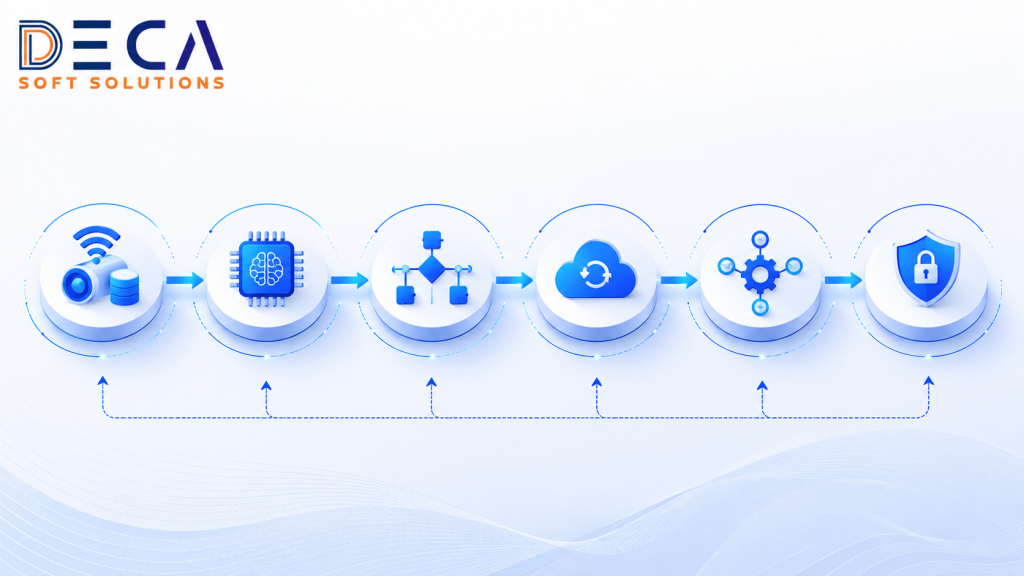
- Sensors and IoT devices: Collect raw data — images, vibration, temperature, location, audio — from the physical environment.
- Edge processors: Hardware accelerators (NPUs, FPGAs, ASICs or GPU modules) provide the compute needed to run deep-learning models within tight power and size budgets.
- Optimized AI models: Lightweight, task-specific models — often produced through quantization, pruning or knowledge distillation — deliver high accuracy while fitting within the memory constraints of edge devices.
- Edge software layer: Orchestration tools that abstract hardware differences so the same model can run across a heterogeneous fleet of devices.
- Optional cloud connectivity: Aggregated results, performance telemetry and model update packages may sync with the cloud for long-term analytics, retraining and fleet management — but the device functions independently when offline.
Why Edge AI Adoption Is Accelerating in 2026
Several converging forces are pushing organizations to move AI workloads to the edge this year.
1. Ultra-Low Latency Is Now a Business Requirement
As 5G networks become mainstream and customer expectations for instant response harden, cloud round-trip latency is no longer acceptable for many automation scenarios. Edge AI delivers the sub-millisecond response times that closed-loop control systems demand.
Trigger → Action: Vibration sensor detects anomalous pattern on a CNC machine → on-device model classifies it as pre-failure → machine halts automatically within milliseconds, before damage occurs.
Example: A mid-sized automotive parts supplier deploys NPU-equipped sensors across its press line. The edge models flag tool-wear signatures in real time, reducing unplanned downtime by over 30% in the first quarter without a single byte of production data leaving the factory network.
2. Data Privacy and Regulatory Compliance
GDPR, HIPAA and a growing number of sector-specific data regulations create real liability when sensitive information is transmitted and stored in third-party cloud infrastructure. Edge AI keeps raw data — patient vitals, biometric reads, proprietary process data — on-premise by design. Only anonymized, aggregated outputs travel externally.
Trigger → Action: Hospital bedside monitor captures patient vital signs → on-device model evaluates early-warning score → alert sent to nursing station within the hospital network, with no raw patient data leaving the ward.
3. Bandwidth Cost Reduction
Industrial IoT deployments can generate terabytes of sensor data per day. Transmitting all of it to the cloud for analysis is expensive and, in many remote locations, simply impractical. By running inference locally, you send only meaningful events and summaries, cutting data transfer costs substantially and reducing cloud compute bills.
4. The Rise of Small Language Models (SLMs)
One of the most significant shifts making edge AI practical at scale is the emergence of compact, task-specific models. Unlike large general-purpose language models that require data-center-class hardware, SLMs are tuned for a single domain — document classification, anomaly detection, visual inspection — and run efficiently on commodity edge chips. Gartner forecasts that by 2027, organizations will use SLMs three times more frequently than large language models, driven largely by edge deployment requirements.
Example: A retail chain deploys an SLM on in-store kiosk hardware to handle product queries and inventory lookups in multiple languages. Response time is under 200 ms and the system operates fully offline during network outages.
5. Advances in Edge Hardware
The latest generation of edge processors — from dedicated NPU modules to energy-efficient ASIC designs — now delivers inference performance that would have required a server rack five years ago. Combined with model compression techniques like quantization (reducing numerical precision without sacrificing accuracy) and knowledge distillation (training a small model to replicate a larger one), these hardware improvements have dramatically expanded the range of models that run on-device.
6. Open Standards: MCP and A2A
Historically, integrating edge devices with cloud services and AI agents required custom, brittle connections. Two emerging open standards are changing that. The Model Context Protocol (MCP) standardizes how AI agents access external data sources and invoke functions — so an edge agent and a cloud orchestrator can share context without bespoke middleware. The Agent-to-Agent Protocol (A2A) handles secure, structured communication between agents, enabling coordinated action across heterogeneous devices and services. Together, they make hybrid edge-cloud architectures far easier to build and maintain. For a deeper look at how these protocols work, see our guide to MCP and A2A for interoperable AI agents.
10 Core Benefits of Edge AI and Real-Time Automation
- Millisecond response times: Local inference eliminates network latency for time-critical decisions.
- Offline resilience: Systems continue operating when network connectivity is lost or unreliable.
- Data privacy by design: Sensitive raw data stays on-device; only processed outputs leave the local environment.
- Lower bandwidth and cloud costs: Transmitting only relevant events rather than raw streams cuts data transfer and storage spend.
- Improved operational safety: Machines can halt, alert or correct themselves faster than any human reaction time allows.
- Regulatory compliance: On-premise processing simplifies compliance with GDPR, HIPAA and similar regulations.
- Scalability without proportional cloud spend: Each additional edge device handles its own compute, so scaling the fleet does not linearly increase cloud costs.
- Reduced dependency on third-party infrastructure: On-device intelligence reduces vendor lock-in and exposure to cloud outages.
- Richer, real-time insights: High-frequency local inference captures patterns that would be lost if data were sampled or aggregated before sending to the cloud.
- Faster iteration with SLMs: Compact, specialized models can be retrained and re-deployed to the edge fleet in hours rather than days, enabling rapid improvement cycles.
Industry Use Cases
Manufacturing and Quality Control
Edge AI cameras on production lines inspect every unit at full throughput speeds — something a cloud-connected system cannot match without enormous bandwidth investment. Models detect dimensional defects, surface flaws or incorrect assembly in real time and either reject the part automatically or halt the line for operator review.
Trigger → Action: Camera captures image of component at end of production line → edge vision model detects micro-crack → robotic arm diverts part to reject bin → quality event logged for process analytics, all within a single conveyor cycle.
Healthcare and Patient Monitoring
Bedside and wearable monitoring devices can run lightweight anomaly-detection models locally, providing clinicians with early warnings for conditions like sepsis, arrhythmia or respiratory distress without requiring a persistent cloud connection. This is especially valuable in settings where network reliability cannot be guaranteed.
Smart Cities and Infrastructure
Traffic management systems using edge AI can adjust signal timing in real time based on live camera feeds without routing video to a central server. In energy infrastructure, edge models on grid sensors can detect fault signatures and initiate protective switching before a fault propagates.
Trigger → Action: Grid sensor detects voltage anomaly → on-device model classifies as incipient fault → protective relay activated within milliseconds → event and context sent to control room for review.
Agriculture and Remote Operations
Autonomous agricultural machinery — sprayers, harvesters, drones — operates in areas with poor or no connectivity. On-board AI models enable real-time crop-health analysis, weed detection and precision application of inputs without cloud dependency, reducing chemical use and improving yield.
Retail and Customer Experience
In-store AI systems can analyze shelf stock levels, queue lengths or customer interaction patterns using local edge inference, feeding operational dashboards and triggering restocking or staffing alerts — all without transmitting customer imagery to external servers.
How to Get Started: An 8-Step Implementation Roadmap
Step 1: Identify High-Value Use Cases
Start with operations where real-time response, data privacy or intermittent connectivity make cloud-only solutions impractical. Map the latency requirement, data sensitivity and expected ROI for each candidate process before committing hardware spend.
Step 2: Assess Hardware and Connectivity Requirements
Choose edge hardware based on your model’s compute footprint, the operating environment (temperature, vibration, ingress protection) and power constraints. Validate that your shortlisted devices are supported by your target edge software stack.
Step 3: Optimize Models for the Edge
Work with your data science or automation partner to apply quantization, pruning or distillation to reduce model size. Where possible, use or fine-tune an existing SLM rather than deploying a large general model — the performance and cost difference on edge hardware is significant.
Step 4: Implement Open Standards for Integration
Use MCP to standardize how your edge agents access data and trigger actions across services. Use A2A to enable secure coordination between edge devices and any cloud-based or on-premise orchestrators. Building on open protocols now protects your investment against vendor changes later.
Step 5: Build a Lifecycle Management Strategy
Plan for over-the-air model updates, performance monitoring and automated alerting from day one. Managing a fleet of edge devices at scale requires tooling for remote diagnostics and rollback — retrofitting this later is significantly more costly.
Step 6: Prioritize Security
Secure edge devices with hardware-level encryption, secure boot processes and trusted execution environments. Define a firmware update cadence and ensure private keys are managed in hardware security modules rather than in software.
Step 7: Pilot Before You Scale
Deploy to a controlled pilot environment that mirrors production conditions as closely as possible. Validate latency, accuracy and fail-safe behavior under realistic loads before rolling out to the full fleet. Document lessons learned and refine your deployment playbook.
Step 8: Plan for Scale and Maintenance
Design provisioning workflows that can onboard hundreds or thousands of devices consistently. Automated testing, remote monitoring dashboards and clear escalation paths for device failures are essential operational foundations.
For organizations also deploying autonomous AI agents alongside edge AI, the same phased approach applies — start narrow, prove value, then expand scope systematically.
Frequently Asked Questions
What is edge AI?
Edge AI is the practice of deploying AI models on local devices — sensors, cameras, embedded systems, robots — so that inference happens where data is generated rather than in a remote cloud. This enables real-time responses, preserves data privacy and allows systems to operate independently of network connectivity.
How is edge AI different from cloud AI?
Cloud AI sends data to centralized servers for processing, which introduces latency and bandwidth costs and requires reliable connectivity. Edge AI processes data locally on the device, eliminating network round trips, keeping sensitive data on-premise and maintaining functionality even when the internet is unavailable.
What are small language models and why do they matter for edge AI?
Small language models (SLMs) are compact, task-specific AI models designed to run efficiently on limited hardware. They require far less compute and energy than large general-purpose models, making them well-suited for edge deployment. Gartner forecasts that by 2027, organizations will use SLMs three times more often than large language models — a shift driven largely by the growth of edge use cases.
What roles do MCP and A2A play in edge AI architectures?
The Model Context Protocol (MCP) standardizes how AI agents retrieve data and invoke external functions, making it straightforward to connect edge devices to broader automation workflows. The Agent-to-Agent Protocol (A2A) ensures secure, structured communication between agents across a heterogeneous environment. Together, they reduce the custom integration work that has historically made edge-cloud architectures complex and brittle.
What are the most common implementation challenges?
The main challenges are hardware constraints (limited compute and memory on devices), the complexity of deploying and maintaining models across large device fleets, integrating edge systems with legacy infrastructure, skills gaps in edge ML engineering, and the upfront capital cost of hardware refresh. A phased approach — starting with a focused pilot on a single high-value process — is the most effective way to manage these risks while demonstrating early ROI.
Conclusion
Edge AI is not a future concept — it is being deployed today in factories, hospitals, smart cities and agricultural operations around the world. By moving inference to the device, your organization gains the speed, resilience and privacy control that cloud-dependent architectures cannot match. The combination of more capable edge hardware, compact SLMs and open integration standards like MCP and A2A has removed the principal barriers that once made edge deployment a specialist undertaking.
The organizations that move earliest on edge AI will build operational advantages that compound over time: faster defect detection, lower unplanned downtime, reduced data costs, and the ability to operate confidently in environments where connectivity is intermittent or regulated. The practical starting point is identifying one or two high-impact processes, building a focused pilot and using that evidence to shape a broader roadmap.
If you would like help identifying the right use cases and building an edge AI architecture suited to your environment, get in touch with the Deca Soft Solutions team.